How the Skydance Conglomerate Will Harm Latinos
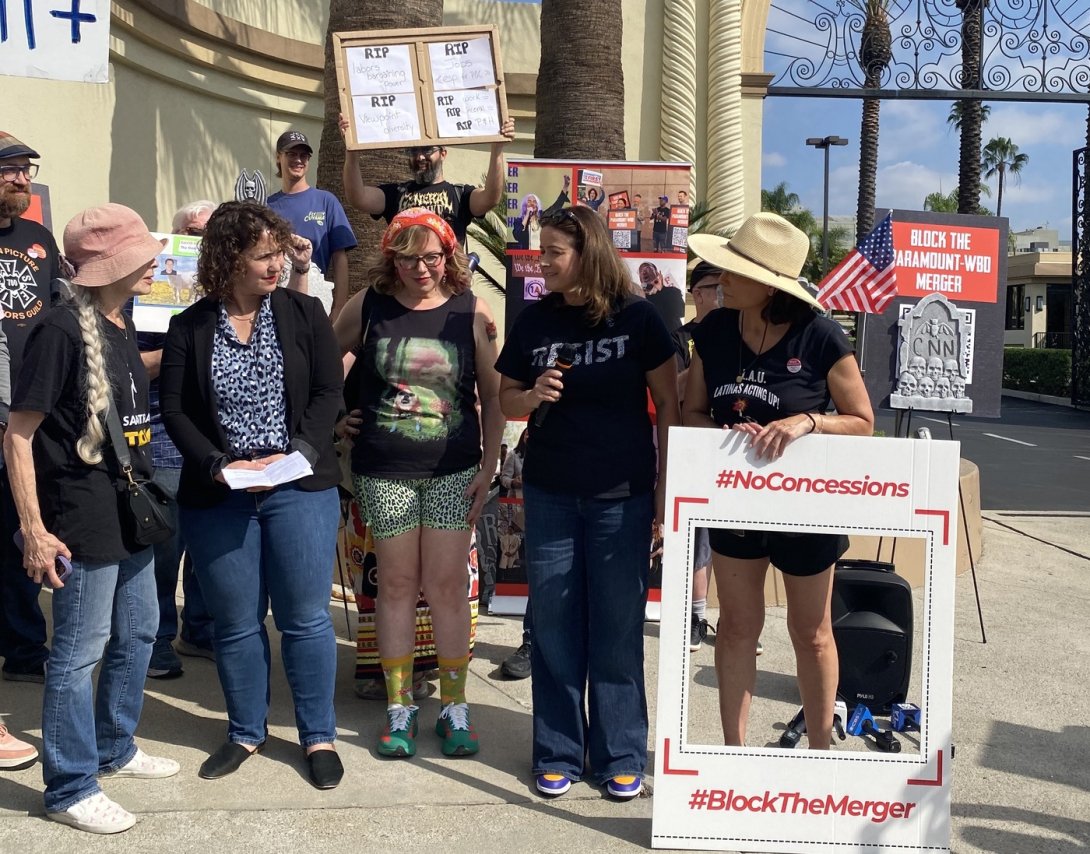
Free Press Co-CEO Jessica J. González (second from right) and other members of the Block the Merger coalition outside Paramount Studios
Ruth Livier, Ph.D.
Capitulating elected officials greenlit the Paramount Skydance-Warner Bros. Discovery merger. The combined company — Skydance — now owns two of the five-largest movie studios, HBO, Nickelodeon, CBS, CNN, CNN en Español, two major news archives and many other prominent media properties. To push the merger through, Skydance chose to take on an $80 billion debt. To pay off the debt, Skydance will eliminate jobs and raise prices — something that happens whenever there’s media consolidation. And as a small cartel of predominantly white billionaires has seized control of our media landscape, people of color will be further stereotyped, misrepresented or ignored in both news coverage and entertainment content.
But this is not business as usual. Unlike past mergers, this behemoth strategically puts an unprecedented amount of our media industry into the hands of an AI-proselytizing Trump loyalist as the president rampages to erase all traces of diversity and normalize white supremacy in U.S. media. As such, the Trump regime has essentially captured a huge swath of our media landscape. Its goal is to use the media to subvert reality by misrepresenting, marginalizing, criminalizing and disenfranchising Latinos and other vulnerable communities while continuing to profit from our labor and consumer dollars.
And this is happening as the regime aggressively targets, surveils and violently attacks Latino communities while muzzling independent reporting in their attempt to control the narrative about Latinos — and ICE’s escalating savagery.
While Latino under- and misrepresentation in U.S. media is not new, this mega-merger will further exacerbate these inequities: It will impact labor opportunities for Latino creatives, harm our audiences and devastate our communities. This is not speculation: Skydance has been constructed on an anti-diversity, equity and inclusion framework.
Paramount Skydance’s allegiance to Trump and his anti-DEI agenda
Paramount was one of the first companies to bow to Trump and his anti-DEI agenda. It quickly abandoned its DEI efforts to get the Carr FCC to approve its merger with Skydance — which it did in February 2025.
Meanwhile, Warner Bros. Discovery claimed it would continue to tell inclusive stories, but eliminated the term DEI to comply with the “evolving legal landscape” — although the law has not changed. Damon Hewitt, president and executive director of the Lawyers’ Committee for Civil Rights Under Law, notes, “Diversity, equity and inclusion is not illegal; it’s not a ‘favor.’ [These] programs are really just ways for companies… to comply with their federal and state civil-rights obligations.… By and large, the law hasn’t changed much at all.”
Once Paramount and Skydance merged, it eliminated roughly 10 percent of its workforce — approximately 2,000 jobs — and focused layoffs disproportionately on people of color and other historically marginalized groups. The company disbanded CBS’ “Race and Culture Unit,” which was created to prevent stereotyping, promote inclusive storytelling, provide cultural context and guide unbiased coverage of race, gender and identity.
That merger also came with the condition that CBS install an ombudsman — and Paramount Skydance hired a right-wing zealot. In response to this move, FCC Commissioner Anna Gomez warned, “The job of this FCC-imposed ‘truth’ monitor must not be to judge whether independent reporting conforms to this Administration’s views and priorities. That’s a clear violation of the First Amendment and the law. Everyone should be watching their actions closely.” Skydance CEO David Ellison is replicating this maneuver at the merged Skydance conglomerate as he installs a fake bipartisan oversight committee, or editorial board, as part of its settlement agreement.
Skydance has been built on an anti-DEI framework and backdoor deals.
What this media capture means for Latinos
Skydance will exacerbate Latino under- and mis-representation in U.S. media. This matters as it impacts labor opportunities for Latino creatives, informs our audiences’ sense of belonging and shapes how our communities are perceived and treated in the world.
The reality is that Latinos are a powerhouse, and key contributors at all levels of society. Latinos are the second-largest U.S. demographic, representing 20 percent of the total U.S. population (as of July 1, 2024), and growing. According to the latest Latino GDP report from UCLA and California Lutheran University researchers, U.S. Latino economic contributions grew to $4.4 trillion in 2024 — meaning that we generate a GDP that surpasses Japan’s, making it the equivalent of the world’s fourth-largest GDP.
The report also finds that Latinos are highly educated: Our educational attainment “grew 3.2 times faster than non-Latinos’ between 2010–2024.” We are employees and employers: The “Latino labor force grew 5.5 percent in 2024, the single strongest growth on record and 4.2 percentage points stronger than Non-Latino.” Between 2007–2023, “Latino owned-businesses increased [in number] nearly seven times faster than non-Latino ones.” And we are consumers: “In 2024, U.S. Latinos’ consumption hit $3 trillion, 25% larger than the entire economy of Italy and 32% larger than Canada.”
But because of existing exclusionary structures, U.S. media have consistently failed to reflect this reality. And under a Trump-allied conglomerate, representational failures will worsen.
Impacts on entertainment media
The merger consolidates decision-making power and will reduce competition. As the Writers Guild of America stated in its lawsuit against the deal, in addition to having the incentive and the ability to lower production costs by suppressing writers’ wages and employment opportunities, “less competition will also reshape what gets made and silence underrepresented voices.” Fewer Latino storytellers telling authentic Latino stories also means fewer jobs for Latino actors, directors and other industry workers.
There’s already an abysmal gap between Latino reality (20 percent of the population) and our representation in entertainment media, which hovers at 5 percent. The merger will mean even fewer work opportunities, lost wages, careers cut short, and reduced access to pension and health benefits.
The L.A. County impact report forecasts likely merger-related job losses, including “2,661 indirect jobs at small businesses that support production, like prop houses, printers, transportation companies, and other vendors… and 3,204 jobs induced from local production spending in the broader economy.” In their letter to California Attorney General Rob Bonta opposing the toothless settlement, the League of United Latin American Citizens (LULAC) clarifies that the impacts of this merger will be devastating to the Los Angeles Latino workforce and community.
LULAC CEO Juan Proaño explains that “the people with the least leverage [are affected] first, and they are the last to recover. In Los Angeles County, where nearly half of the population is Latino, that means the grips, electricians, drivers, set builders and caterers, and the small vendors who supply them.”
Impacts on newsrooms
Media consolidation has also historically resulted in news deserts, harming local newsrooms and the communities they serve. Under Trump, independent journalism is under attack. “This merger will have serious negative impacts on Latiné communities,” said Vanessa Maria Graber, director of journalism and media education at Free Press. “It will be harder for us to get media and journalism jobs in an already exclusionary market, there will be less coverage of our communities’ important issues and there will be increased discrimination. I expect more journalists will be silenced when reporting on the impacts of Trump’s mass deportation campaign, and we’ll see more propaganda and disinformation targeted at Spanish-speaking communities.”
In a May 12, 2026 letter to David Ellison, Reps. Frank Pallone Jr. and Jamie Raskin stated that “President Trump expects [Ellison to] produce favorable press coverage for him and his allies,” noting that the Ellison family had reportedly “offered assurances to Trump administration officials that if they bought Warner Bros., they’d make ‘sweeping changes to CNN.’” Their letter also points to how Ellison has repeatedly demonstrated his allegiance to Trump through a series of editorial concessions and settlements.
At stake is the truth about Latinos and Latino disenfranchisement as the regime aims to spread pro-Trump propaganda by capturing corporate news media while defunding public media. There’s a risk that coverage will deliberately misrepresent ICE’s violence and the regime’s incessant and violent attacks against both activists and reporters covering anti-ICE protests. As with any authoritarian takeover, the communities under attack will be vilified in captured media.
Impacts on Latino audiences
For Latino audiences, representational failures in both entertainment and news media have real, material and measurable impacts. These failures inform audiences’ sense of belonging. They also shape people’s perceptions and perspectives about Latinos, which can affect our access to social protections, resources, benefits, labor opportunities and inclusion in decision-making spaces.
“The research on how people process entertainment reveals that media becomes a strong part of their lived experience,” said Dr. Ana-Christina Ramón, director of the Entertainment and Media Research Initiative at UCLA and lead author of UCLA’s annual diversity reports. “… If you see something repeated over and over again, then you begin to believe it, even if it’s not necessarily true.” Our exclusion from the media also impacts our exclusion from the archives.
When the public loses access to a robust and independent media ecosystem with journalists who are free to do their jobs — the very thing a democracy depends on — the result is a silencing of dissent, the spread of unfettered mis- and disinformation, and the dismissal or erasure of the lived experiences of diverse groups. In this way, trust is eroded, hindering people’s ability to fully participate in our democracy.
And the defunding of the Corporation for Public Broadcasting has impacted U.S.-Spanish speakers as local news, cultural programming, educational shows and public-service broadcasts are essential to millions of people who either don’t speak English fluently or prefer to receive information in their native languages. According to the CPB, at least 77 public-media stations in 30 states, Puerto Rico and the District of Columbia offer Spanish-language programming. Because non-English speakers tend to identify as people of color, linguistic racism and anti-immigrant rhetoric become intertwined.
It is also unnerving that the Skydance conglomerate is headed by David Ellison, an AI zealot, and largely financed by his father, Larry Ellison, co-founder of Oracle, a company that is heavily invested in AI technologies. These technologies are being used for mass surveillance and are being positioned to replace human workers — and can be used to further whitewash the media. For example, translation technologies can take us back to the time of white actors in Brown faces by allowing white actors to “speak” any language, which begs the question: Who will get to work at Skydance? And white men can further profit from Brown and Black bodies, as this Instagram video that journalist Joy Reid reposted shows. The content creator reveals that white men are behind some of the Black “AI Personas” on Spotify.
While the regime marginalizes, attacks and misrepresents us, Latinos drive profits.
They attempt to erase us while profiting from us
Latinos drive media-industry profits. In 2019, while attendance decreased for other groups, a Motion Picture Association study showed that Latinos “continued to overrepresent with the highest annual [movie-going] attendance per capita, going to the cinema 4.7 times a year.” In 2020, Latinos purchased 29 percent of all movie tickets sold. And a 2026 Pew Research Center study found that 59 percent of Latino adults visited a movie theater in the past year, compared to white (53 percent) and Black (49 percent) adults.
And yet they erase us. After its 2022 merger, Warner Bros. Discovery shelved a finished $90 million film, Batgirl, with an Afro-Latina lead; canceled Gordita Chronicles, a popular comedy about a Dominican immigrant family; and canceled other series featuring people of color and women in lead roles. And in 2025, people of color lost ground in all key Hollywood employment categories — directors, writers, lead actors and overall cast.
Despite these attempts at erasure, in 2025, films with casts between 41–50 percent people of color earned the highest median box office of any group. And the 2026 Oscar nominees demonstrate that diversity continues to win in terms of popularity and profits. Sinners earned $371.6 million worldwide and KPop Demon Hunters broke new ground as Netflix’s first-ever #1 box-office hit, grossing $24.6 million. Furthermore, “the most-streamed films in the past four years have been led by young girls of color: Encanto, Turning Red, Moana and then KPop Demon Hunters,” said Dr. Ramón. Plus, Bad Bunny’s 2026 Super Bowl halftime show hit 128.2 million viewers, and broke NFL social-media records.
“To say that diversity is not something people want to see is just ridiculous,” said Ramón.
“Diversity sells, but media conglomerates are more interested in white supremacy,” writes Free Press’ Cristina Escobar.
The way forward is to leverage our power
Latinos are key to our society today and to our country’s future. That a Trump loyalist now controls so much of our media landscape is unsettling. The impacts will fall disproportionately on Latinos and other historically marginalized groups as diverse stories and storytellers are further erased from view.
The regime aims to normalize white supremacy while complicit media owners continue to profit from Latino communities.
Their goal is to misrepresent and erase us in order to devalue, dehumanize and strip us of our rights. They want our labor and consumer dollars while relegating us to the margins. Of course, this is not new, but it will get worse. Fortunately, Latinos are a powerhouse. Our numbers and cultural and economic power have increased despite the government’s historically racist immigration system and a media industry undergirded by white supremacy. The way forward is to leverage our power while holding steadfast in multiracial solidarity.
Our call to action is for workers to push their union leaders to stand up for their diverse members, for the media to hold power to account, and for the public to stand in solidarity and hold elected officials accountable. Join Free Press and our Block the Merger coalition partners to stay up to date with our advocacy work and other opportunities to take action.
****
Help Free Press keep fighting media consolidation: Donate today.