What Massachusetts Residents Told Me They Need from Local News
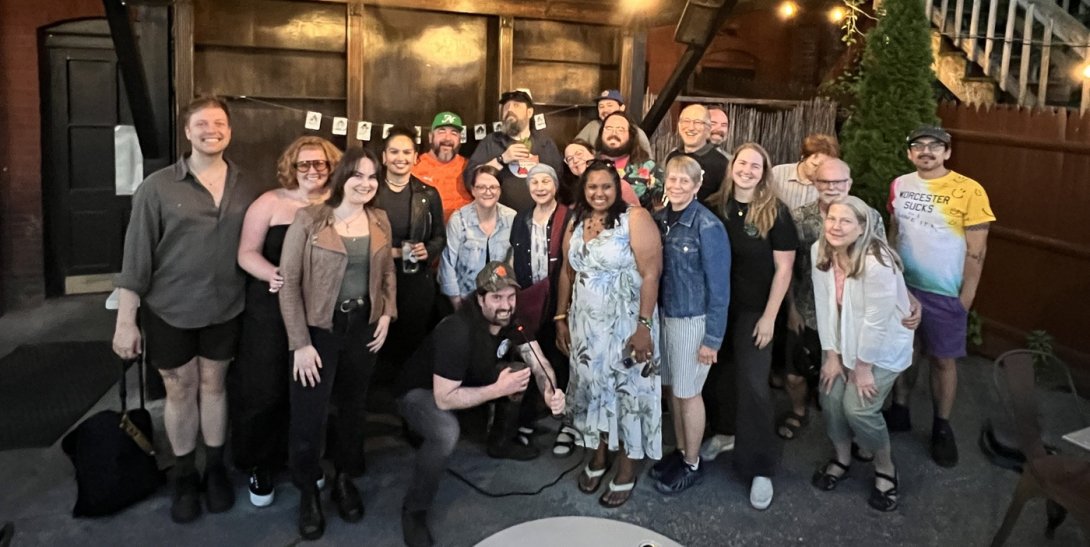
The author with others celebrating the six-year anniversary of the newsletter “Worcester Sucks and I Love It,” which reports extensively on local government.
Sarah Stone
Like so many people across the country, Massachusetts residents face serious barriers to accessing reliable local news.
This has an adverse impact on civic life, from lower rates of democratic participation to higher rates of loneliness. The effects are felt most acutely in rural, working-class, multilingual and BIPOC communities — and in places that have long been undercovered and underresourced — but this crisis impacts people all across the commonwealth. The end of federal public-media funding and the fallout of corporate consolidation — including the shuttering and merging of dozens of Gannett papers — are only adding fuel to the fire.
Building power with the Massachusetts Media Power Collaborative
Although it’s a daunting challenge, people across Massachusetts have begun organizing to secure public funding to treat local news as the essential public good it is. For the past year and a half, the Free Press Action team has worked closely with media leaders and allies to build the Massachusetts Media Power Collaborative, a statewide coalition advocating for local news and information. We’ve traveled across the state to talk with journalists and small publishers, college students and professors, community organizers, librarians and everyday residents.
We conducted a statewide listening tour and organized a lobby day in Boston in support of public grantmaking to fund local news and information. Modeled on the New Jersey Civic Information Consortium, a public-grantmaking body would fund outlets and organizations based on how well they serve communities’ civic-information needs regardless of their business models or the number of journalists they employ.
This summer alone, I drove almost 1,000 miles around Massachusetts — traveling everywhere from Beverly and Fitchburg to Haverhill and Worcester — to learn how access to local news and information impacts people’s lives. People told me how losses in local-news coverage have impacted their communities, and noted how hard it is to find trusted information in an ecosystem saturated by divisive and inaccurate social-media content. People also discussed what’s working at the local level to help them find the information they need.
A summer of community listening
In June, we visited allies, newsrooms and community-media stations in Belmont, Framingham, Haverhill and New Bedford. I spoke with community members at the six-anniversary celebration for the newsletter “Worcester Sucks and I Love It,” an alternative news source for Worcester residents that reports extensively on local government. I also joined the League of Women Voters’ panel discussion “What Democracy Means in Everyday Life: Freedom of the Press” at NewTV in Newton with journalism professor Dan Kennedy of Northeastern University and reporter Steph Solis of Axios Boston. And I attended a live taping of GBH Amplifies at the Boston Public Library featuring the Bay State Banner, one of the nation’s most renowned Black-owned and Black-led newspapers.
In July, Free Press Senior Producer and Cultural Strategist Julio Ricardo Varela — a longtime Boston-based journalist — worked closely with the team at El Planeta to produce a short video about information access in Chelsea featuring Spanish-speaking residents, community leaders and Rep. Judith García. We also led two trainings for coalition members to conduct outreach and engage their communities in advocating for local news and civic information.
In August, summer fellow Angela Chen and I led a listening tour in Boston and Quincy focused on AAPI-led newsrooms and community organizations. We met with the Asian American Resource Workshop, the Boston Korea newspaper and Quincy Asian Resources, Inc., and interviewed residents at the August Moon Festival in Chinatown. I organized a community-listening session in partnership with Fitchburg Access Television (FATV) to learn how the disappearance of local news affected this community’s civic health. I also met with a group of small publishers on the North Shore to hear how they’re keeping their readers informed about important local issues.
Communities know what they need
There are three key lessons I’m taking away from our organizing work that serve as important reminders for policymakers who want to support local news and information.
Communities have very different needs. We talked with a grassroots organizer in Dorchester with the Asian American Resource Workshop, who goes door to door making sure elderly Vietnamese residents know about local elections and other important news. I spoke with people in rural towns where Facebook pages have filled a vacuum for local information, but often spread misinformation, polarize people and erode civic trust. Some communities can sustain subscription-based news outlets, but in others, people are struggling to meet their basic needs and can’t pay for local journalism.
Policies that aim to address the crisis in local news — not only as an industry crisis, but as a crisis for democratic engagement and civic health — must be nimble enough to meet these diverse needs. Funding distribution should be guided by what people need to stay safe, connected, informed and engaged, with enough flexibility to support trusted local organizations that help people access this information in the ways that work best for that local context.
Public funding is essential to keeping communities informed. Across the board, every conversation I’ve had has come back to funding: How can we build a sustainable funding model that supports the outlets and organizations helping people access the information they need most?
There is no shortage of creative ideas to reach new audiences, form new partnerships or cover local issues. People pour their lifeblood into these small newsrooms, working long hours for little pay, because they see the positive impact it has on their communities. Some newsroom leaders in our coalition don’t know if they’ll have enough funding to operate from one month to the next.
Yet although almost everyone shares the need for more funding, the information gaps these outlets work to address vary in severity. Resources should be prioritized for communities that face the most drastic challenges to accessing civic information, and this requires dedicated public funding to meet a critical need that the commercial market has failed to address. Creating public funding streams to support this work would let the most impacted local newsrooms and outlets do what they do best: Serve and inform their communities.
Our organizing is paying off: The coalition building we’ve done in Massachusetts has shown that we need communities to help shape policies and investments in local news. Public investments should be rooted in local conversations about the loss of coverage, the impacts of social media on civic life, the hyperlocal issues that larger outlets ignore, and the kinds of storytelling that restore people’s sense of pride in their community.
It’s also critical that these coalitions bring together the people working every day to keep folks informed where they live. Whenever I gather in a room of community members, journalists or students, someone inevitably says, “We’ve all been connected online for a long time, but we’ve never all gotten in the same room to talk about this issue together.” Those relationships are the building blocks of a powerful grassroots coalition, and they have ripple effects beyond any singular policy win.
And the more we organize, the more elected officials are taking note. During our lobby day in April, lawmakers stopped coalition members in the hallway, asking how they could support the local civic reporting that provides such a benefit to their communities. As our efforts have expanded across the state in the months since, we’ve seen a notable shift in how lawmakers are talking about the challenges people face in regard to local news — and the need for policy changes that center communities’ needs.
Massachusetts has an opportunity in 2027 to make a lasting public investment in a stronger, more diverse and community-rooted civic-information system — one that directs resources toward unmet needs, supports the people best positioned to meet them, and measures success by whether communities are actually better informed and connected at the end of the day.
This summer showed us that Massachusetts already has the people, ideas and local institutions needed to do this work. What they lack is sustained and equitable investment — and we have an opportunity to build on the energy we’re seeing for community-centered policy solutions.
****