Threats to Local Journalism Show Why We Need Stronger Media Policy in Wisconsin
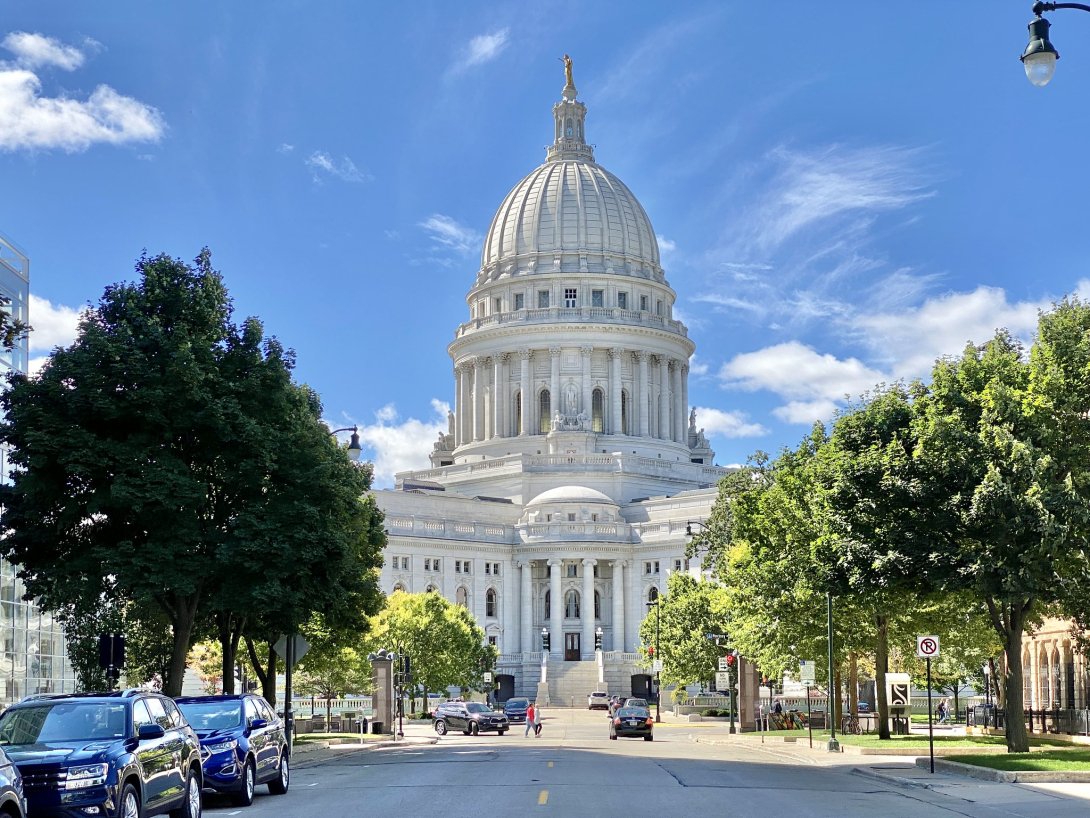
Wisconsin is one of only 10 states that in 2025 received an F rating for failing to pass legislation to protect free speech and local journalists. A bill introduced in the Wisconsin statehouse (pictured) could be a game changer.
Flickr user Warren LeMay
Journalists work tirelessly to keep the public informed. But that goal is difficult to achieve in an increasingly threatening reporting environment.
The number of attacks on the media has drastically increased over the last year. Being a journalist is challenging enough, with layoffs and mergers creating constant job insecurity — so imagine the toll it takes on reporters when their safety is at risk, free speech is not so free and censorship is at an all-time high.
In Wisconsin, the threat of expensive lawsuits for critical reporting, funding losses and restrictions on recording public meetings prevent us from having access to accurate and reliable news and information about what’s happening in our state. This makes it all the more important for us to organize around stronger media policies to help journalists do their jobs and protect the rights of all Wisconsinites to stay informed and engaged in public life.
In November, I traveled across Wisconsin to learn more about the threats facing journalists, local news and free speech. I spoke with journalists, lawmakers and community leaders about the challenges that undermine access to reliable local news and information — and how Free Press Action can support those advocating for stronger media policies and community-rooted information.
Here’s a look at some of the challenges and opportunities we discussed.
Wisconsin is the only state in the Great Lakes region with zero SLAPP protections
One form of intimidation that journalists face is strategic lawsuits against public participation, or SLAPPs — like the lawsuit brought against the Wausau Pilot and Review in 2021. These lawsuits can be used against individuals and organizations to intimidate and silence public critiques. Plaintiffs bring expensive legal proceedings against defendants, who are then forced to rack up enormous legal fees defending themselves against baseless charges.
The Institute for Free Speech’s recent Anti-SLAPP Statutes: 2025 Report Card gave Wisconsin and 10 other states an F rating for failing to pass legislation to protect free speech and local journalists. But there’s an opportunity to change this in Wisconsin in 2026, as state lawmakers have introduced new anti-SLAPP bills that adopt the Uniform Public Expression Protection Act (UPEPA), and would protect journalists and ordinary community members from these lawsuits. SB 666 and AB 701 have both passed out of committee unanimously with bipartisan support.
This comes a little more than a year after the Wausau Pilot and Review — an independent local-news nonprofit — was in danger of closing after a politician sued it. After a circuit court sided with the local outlet, the case was dismissed — which prompted the plaintiff to file an appeal. The subsequent decision only affirmed the lower-court ruling. Although it won in court, the Wausau Pilot and Review racked up nearly $200,000 in legal fees, putting it at risk of closure. Fortunately, the organization created a successful GoFundMe that enabled it to continue operating despite these threats.
This is a prime example of why SLAPP protections are necessary. If it passes, the Uniform Public Protection Act will allow a person sued in a SLAPP suit to file a motion to strike the lawsuit if it arises from their constitutional right of petition or free speech in connection with a public issue. In addition, if a defendant prevails on a special motion to strike, a court must award it all court costs, reasonable attorney fees and reasonable litigation expenses related to the special motion. With the introduction of this legislation, Wisconsin is taking the first steps toward better protecting its journalists and members of the public from these harmful suits.
The country’s only independent state-capitol broadcast network shuts down
Journalists, lawmakers and other concerned community members are rallying to respond to another major threat to free information in Wisconsin: After 20 years of operation, WisconsinEye — the state’s version of C-SPAN — went offline last December due to lack of funding. WisconsinEye was a nonprofit, private public-affairs cable network that provided nonpartisan, unedited, state-government news. WisconsinEye typically offered livestreams and broadcast coverage of legislative hearings, floor sessions and other state-government business; it also maintained a database of over 30,000 hours of archive footage that is now offline.
Leading up to this decision, last November the nonprofit announced that it was in critical need of funding and even turned to the state legislature for support. In the 2025–27 Wisconsin state budget, Gov. Tony Evers and lawmakers agreed to provide $250,000 in funding for WisconsinEye, and pledged to provide matching funds of up to $9.75 million if the organization raised $10 million for its endowment fund by June 2026. WisconsinEye President Jon Henkes asked lawmakers and the governor to remove the provision requiring an endowment match and to release a portion of the funds to keep the organization from going offline. Lawmakers refused to release the funds, and on Dec. 15, Wisconsin Eye officially went offline, with a message on its website reading “WISEYE.ORG IS OFF THE AIR.”
Lawmakers quickly introduced a bill to create the Office of Public Affairs Network, which the state Department of Administration would run (this network would essentially replace the WisconsinEye). The bill would provide $2 million annually in public funding for continuous coverage of legislative floor sessions, executive-branch proceedings, Supreme Court hearings and press conferences. Another proposed deal would create a trust fund to support WisconsinEye with the $10 million that was intended for the endowment match, using interest from the trust fund to support coverage of the state capitol.
While it’s encouraging to see lawmakers call for public funding to support public-information access, there are more comprehensive, sustainable solutions. Wisconsin could create a public-grantmaking body patterned after the New Jersey Civic Information Consortium, which has distributed over $12 million to news outlets and community organizations since 2021. A similar bill was introduced in Wisconsin in 2024, and reintroducing this legislation would be a powerful step toward supporting organizations like the Wisconsin Eye in the future. (The nonprofit has launched a $250,000 fundraising campaign to try to get back online.)
Lawmakers ban members of the public from recording statehouse meetings
Not even a month after the devastating loss of WisconsinEye, Republican lawmakers began enforcing a measure that bars members of the public from photographing, videographing or recording state legislative meetings unless they are a “credited correspondent of the news media.”
But this isn’t slowing down any meetings happening in the Capitol. And for the first time in nearly 20 years, you have no idea what’s going on in those rooms unless you were there, or unless a credentialed reporter was present. This creates a much heavier burden on already-understaffed newsrooms trying to cover legislative meetings — and it makes the closure of Wisconsin Eye even more of a crisis with this newly enforced rule against recording.
The timing of this rule’s enforcement couldn’t be worse. It prevents transparency and public engagement on issues of public interest. It’s more important than ever for journalists to inform the public about these developments so people can hold their elected officials accountable and demand greater transparency. The combination of these threats creates an important moment for journalists, civic organizations and members of the general public to build support for stronger policies that protect free speech, transparency and funding for local news.
An important moment for public action to demand policy change
As I’ve been writing this blog, I’ve been asking myself: How can we expect journalists to do their jobs if they don’t feel safe? How do we expect them to keep the public informed if they can’t get access to information? How can we make sure Wisconsin residents know what’s happening in their state government?
One important step is to advance stronger media policies that protect journalists and support local news and access to information. If passed, the Uniform Public Protection Act would be a good start for Wisconsin — but it’s only a start. In 2024, Wisconsin lawmakers introduced a separate package of bills to support local news across the state. Modeled after the New Jersey Civic Information Consortium, the country’s first public-grantmaking body to fund civic-media projects, this legislation would address major concerns surrounding the local-news crisis impacting Wisconsin and the civic health of its communities.
These policies don’t solve every problem, but they do protect journalists, support local news and address major concerns around public access to trusted, reliable information. In New Jersey, the fight for public funding to support local journalism grew out of a statewide movement for the kinds of news and information people need to engage in their communities. Starting with anti-SLAPP legal protections, Wisconsin can take a first step toward a safer and more transparent environment for journalists, building toward a long-term vision where quality local journalism is treated and funded as a crucial public good.
Help Free Press Action keep fighting for stronger local journalism: Donate today.