Despite the Efforts of Hardworking Journalists, Wisconsin's Local-News Infrastructure Is in Dire Need of Support
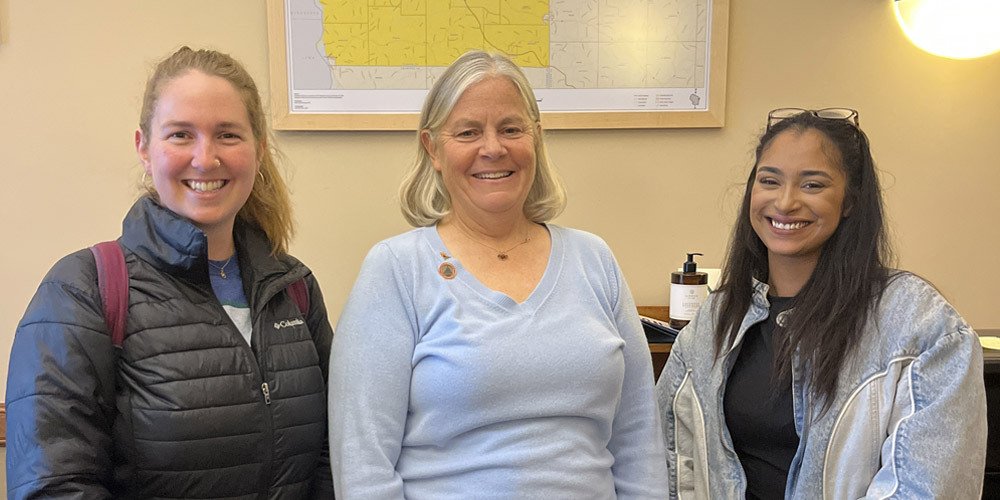
Free Press Action’s Sarah Stone and Arin Anderson with Wisconsin State Rep. Tara Johnson (center)
It’s no secret that local news is shrinking and disappearing across the country, and Wisconsin has been one of the hardest-hit states.
Since 2004, Wisconsin has lost roughly 60 percent of its newspapers, with local newsrooms shuttering at an accelerating rate in the past six years.
As a Milwaukee native who has spent most my career organizing across Wisconsin, I have seen firsthand how the lack of news and information affects communities — and more specifically their civic health. That’s what brought me to this work with Free Press in the first place.
Wisconsin residents express the need for trusted information sources
While supporting a previous statewide project, I sat down with a diverse group of Wisconsin voters to learn where they got their civic information from. And guess what? Not one person could name a news source that they could trust and rely on. At that moment, I realized that was a larger issue in itself. Shortly after, Free Press was hiring in Wisconsin. I couldn’t shake the thought of Wisconsinites feeling as if they had no reliable year-round information sources, so I applied. And now here I am, driving throughout Wisconsin, talking to people about how they get local news and information.
Now, I don’t come from a journalism background, and I didn’t know much about media policy before joining the Free Press team. But what I do know is that people need news and information. When I was organizing around the 2023 Wisconsin Supreme Court race, countless voters said they didn’t even know there was an election. How can people vote if they don’t know there’s an election?
With the growing concerns around the local-news crisis in Wisconsin, it was a no-brainer that the first step in this work was to get a lay of the land — in this case, the Dairyland. So, I traveled across the state to learn about communities’ unique information needs. I wanted to learn about the different folks working to meet those needs — and find out what support they need to continue to do so.
On a listening tour through America’s Dairyland, I traveled through three different regions in Wisconsin, stopping in both major cities and rural communities, including Eau Claire, La Crosse, Madison, Menomonie, Milwaukee and Viroqua. We had the opportunity to sit down with community-rooted journalists and newsroom leaders, researchers, civic and service organizations, and state lawmakers to uncover what challenges they’ve faced — and explore ways we can work together to support local news across Wisconsin.
Here’s what I learned.
The loss of local news and information has a direct impact on Wisconsin’s civic health
The loss of local news and information is accelerating — and harming the state’s civic health. A 2024 report from the University of Wisconsin Population Health Institute even names access to local news as one of several factors determining civic health. From the lack of government accountability to the increase in political polarization and decrease in civic engagement, it’s evident that access to information is crucial for a strong democracy.
I’ve heard from journalists about the loss of journalists covering the statehouse, and when I visited the State Capitol Press Room, there were only a few staff members working quietly behind their desks with the door closed. One local nonprofit newsroom focused on statehouse coverage, Wisconsin Eye, announced that unless it can raise sufficient funds, it will need to stop covering events and its video archive will go offline. Thankfully, local-newsrooms like The Wisconsin Examiner , a nonprofit, nonpartisan newsroom in Madison offering investigative reporting and daily coverage, and Wisconsin Watch — another nonprofit, nonpartisan investigative news outlet serving the state — are working to fill those gaps through accountability journalism, statehouse reporting, and access to civic information and education.
Non-traditional media outlets play a crucial role in Wisconsin
As news operations have shifted online and print circulations have declined, newsrooms such as Milwaukee Neighborhood News Service (NNS) and Volume One are exploring creative ways to reach their audiences and engage with community members.

Free Press’ Sarah Stone and Arin Anderson with Milwaukee Neighborhood News Service Executive Director Ron “Ronshine” Smith and Wisconsin Watch Managing Editor Jim Malewitz
When we visited NNS’ office on the Marquette University campus, we got to meet Executive Director Ron “Ronshine” Smith and Managing Editor Edgar Mendez to learn more about how the outlet engages with Milwaukee communities. NNS launched News414, a service-journalism collaboration of three nonprofit newsrooms: Milwaukee Neighborhood News Service, Outlier Media and Wisconsin Watch. Through text, News414 delivers reliable information and resources to Milwaukee residents focusing on five key issues: food security, housing, health and safety, jobs and money, and mental health and domestic violence. This way, NNS can ensure information gets directly into the hands of those it serves.
As we drove west to a smaller rural town, we learned about another creative model of media shaping community engagement. Starting off as a zine distributed around the city of Eau Claire in 2002, Volume One has grown to be a staple in the community and a trusted information source. Volume One has expanded into a free print magazine and the home of both a popular gift shop called The Local Store and a trolley service that travels throughout Eau Claire. Volume One has played a key role in shaping the culture and growing community in Eau Claire, from hosting local events with food trucks and live music to publishing a detailed events calendar highlighting dozens of ways to gather with other community members. As the media landscape continues to grow and change, non-traditional media outlets have been playing a vital role in keeping Wisconsin communities informed and engaged.
Rural communities in Wisconsin face unique challenges in the face of the local-news crisis
When it comes to the decline and outright disappearance of local news, rural communities have taken a huge hit. According to the 2018 report The Expanding News Desert, more than 500 of the 1,800 newspapers that have closed or merged across the country since 2004 were in rural communities. And the news outlets that remain often have few or no full-time journalists covering these communities. More than 22 counties in Wisconsin have only a single local newspaper, and communities like Bayfield don’t have a local paper at all. And these publications often face steep challenges as they struggle to keep their newsrooms running with limited staff and funding.
During our trip, we sat down with two online newsroom leaders working to keep their rural communities informed: Steve Hanson, who runs Eye on Dunn County, and Tim Hundt, who runs The Vernon Reporter. Eye on Dunn is one of only three online news sources covering Menomonie, Wisconsin. Just one person runs these newsrooms, so you can imagine how impossible it is to fill all the coverage gaps.
Rural communities face several challenges that put them at higher risk of becoming news deserts. For starters, not everyone in these communities has broadband access, limiting their ability to access important local information that is sometimes only available online. It’s also more difficult for rural newsrooms to expand, especially when they are strapped for time and resources. Some journalists aren’t even able to pay themselves, let alone pay someone else. In places like Menomonie, Steve told us about the lack of access to health care and birthing centers: With rural health centers closing, it’s more difficult to recruit new staff to the area to support the news outlet’s work.
Reliable, trusted local information is a true public good
Despite the effort of hard-working journalists, Wisconsin’s local-news infrastructure is in dire need of change and support. In 2024, Wisconsin lawmakers introduced a package of bills to support local news across the state. Modeled after the New Jersey Civic Information Consortium — the country’s first public grantmaking body to fund civic-media projects — this legislation would address major concerns surrounding the local-news crisis impacting Wisconsin and the civic health of its communities.
With more state policymakers searching for solutions to ensure that the public has access to quality news and information, we will continue to be on the ground in Wisconsin working to create real changes to local-media systems because we know that reliable, trusted local information is a necessary ingredient for civic and democratic engagement.
Help us keep fighting for stronger news and information in Wisconsin: Donate today.