As Surveillance Ramps Up, a New Campaign Amplifies Ways to Fight Back
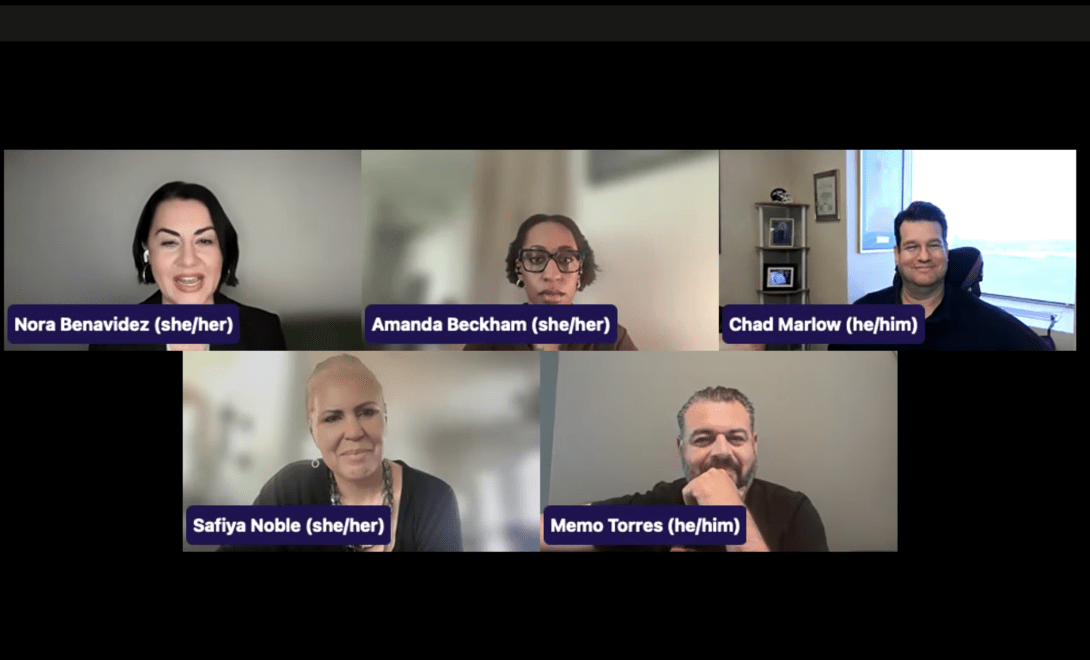
The Solidarity Over Surveillance launch webinar featured advocates engaged at the forefront of the various battles for our rights to privacy and dissent.
Across the country, communities are standing in solidarity against corporate and government-sponsored surveillance — a problem that has escalated under the Trump administration. This June, Free Press, the Disinfo Defense League and dozens of grassroots, civil-rights and press-freedom groups launched the Solidarity Over Surveillance (#SOS) campaign. The campaign is designed to counter the rise of authoritarianism by uniting communities to put an end to the extraction, storage and use of our data. The message is clear: Enough is enough.
The threats at a time of AI-powered surveillance
To teach people about the goals of the Solidarity Over Surveillance campaign and the issues at stake, organizers hosted a panel discussion, which Free Press Senior Policy Counsel Nora Benavidez moderated. The conversation featured advocates engaged at the forefront of the various battles for our rights to privacy and dissent.
Chad Marlow, a senior policy counsel at the ACLU, is one of the intellectual hubs for anti-surveillance policy; he’s done groundbreaking research on student surveillance and directs the organization’s efforts to help communities take back control over police surveillance. Safiya Noble, the director of the UCLA Center on Resilience & Digital Justice, is one of the original voices revealing how algorithms are biased systems. Journalist Memo Torres, the director of engagement at L.A. Taco, started off rating tacos across Los Angeles; when the ICE raids began, he began monitoring the crackdown in his community.
All of the panelists are united by a deep concern for how surveillance is impacting our communities. Noble made it clear that from a certain vantage point, an event like this webinar is a threat to federal actors intent on surveilling us — and our panel wasted no time in showing us why.
This webinar came as local heroes are rising up and fighting back against surveillance in their communities. From speaking out at open government meetings in opposition to AI data centers to people covering invasive Flock cameras with trash bags, the pushback has spread beyond political-party lines — and the tide is turning against surveillance in a way that our government can no longer ignore.
As Trump’s authoritarian directive to expand surveillance faces significant community opposition, he is moving to criminalize resistance. A memorandum Trump signed in 2025 calls for the designation of his perceived enemies as domestic terrorists. The memorandum calls for the creation of a National Joint Terrorism Task Force to investigate a broad category of organizations and individuals engaged in constitutionally protected dissent. “This administration and their cronies are not even hiding anymore,” Torres said. “They are putting it out in the open. This is the new state that they are pushing.” Meanwhile, the Department of Justice is now pursuing criminal charges against protesters in Minnesota, infiltrating Signal group chats to gather sensitive information about organizing against ICE.
During the discussion, Torres recounted the ways in which he saw his own community members targeted during the ICE raids in Los Angeles. He discussed how private companies like license-plate reader Flock and Palantir have fueled government surveillance; Flock has enabled DHS arrests by allowing agents to access data from the company’s over 90,000 AI-powered cameras and devices. Palantir provides over 20 million targets that are accessible to ICE and other law enforcement through its software. Torres described the chilling atmosphere in L.A., noting how a combination of surveillance tech and data extracted from our own devices allows law enforcement to spy on protesters and terrorize Latine communities with arbitrary detention and deportation.
Companies compete to develop new ways to track us
Big Tech has launched an arms race to expand the use of surveillance and enable the government to target, find, and incarcerate or even deport perceived enemies. Companies like Oracle, Palantir and SpaceX are lining up to bid on government-defense contracts to expand the infrastructure for these technologies. ICE is paying Palantir over $30 million for software to help agents choose who to deport.
While this capitulation and collusion between Big Tech and the federal government may seem novel, Noble reminded us that what we are experiencing today is just the continuation of a long history of state surveillance and repression. Just as the enchantment of the early internet clouded criticism of its Department of Defense origins, tech companies are betting the enchantment of AI’s promise will cloud criticism of their role in facilitating an authoritarian agenda.
“These systems are being used against people in court,” Noble said. “Digital profiles are created and materials scraped to paint us as criminals. That profile is standing as a proxy for who you are by the government and that is horrifying.”
These profiles are used to predict your behavior and movements, enabling predictive policing where police target individuals based on the suspicion of crimes they have not yet committed.
“All of the AI systems have predictability models to understand your patterns [and] study how you act. And the moment you start acting out of line, if a pattern changes, they notify police to follow and check you,” Torres said. “But AI is not perfect. We’re seeing it now with people applying for jobs. A lot of companies are now using AI models to see if they’re going to accept your resume or not. It’s not going to affect you until it does.”
Modern surveillance tech that’s used to police communities operates on biased algorithms trained on a long history of targeting Black and Brown communities. Automated discriminatory decision-making tools like predictive policing and AI job screening continue the legacy of surveilling community dissent against sexism, racism, homophobia, xenophobia and poverty. In this country, this history reaches as far back as the 1700s Lantern Laws that restricted and tracked the movements of Black Americans.
Police surveillance puts us all in increased danger by targeting Black, Latine, queer and immigrant communities. Marlow explained how surveillance is a threat to everyone’s privacy — but it doesn’t impact everyone equally. As police deploy surveillance tech to criminalize and harass Black and Brown communities, federal intelligence agencies conduct broad searches of our data — violating our Fourth Amendment right to privacy. When local police spy on the movements of local organizers, protesters and journalists through the use of Flock license-plate readers and other technologies, they chill the dissent in that community through fear and repression.
Marlow did not mince words as he explained that “the main impact of surveillance is that it forces people to self-regulate themselves to avoid the risk that they are seen doing something wrong. So that is why when we lose our privacy to surveillance, we also lose our right to free speech.”
When this happens, Marlow noted, people are relinquishing their First Amendment rights. “Facial recognition misidentifies people of color, especially, it seems, Black men. If an immigrant or someone who is Black, Brown or low-income ends up in the back of a police car or in prison, that’s [considered] an acceptable consequence of the surveillance state and that should bother us all.”
Privacy advocates want to empower communities to fight back
The Solidarity Over Surveillance Campaign seeks to empower and unite targeted communities while calling on lawmakers to limit the data the government can obtain without a warrant. Our panelists, each with their own track record of documenting, researching and building solutions, provided attendees with various tactics to resist surveillance. #SOS will empower allies to fight for surveillance reform in state capitols — and to protect our basic privacy and free-speech rights.
On the ground, #SOS organizers are working both nationally and hyperlocally to resource, connect and empower targeted communities as they speak out and challenge the surveillance apparatus. This programming aims to build community awareness and resilience to surveillance through joy and action.
A series of “disco techs,” community salons and privacy parties dot the summer calendar, bringing communities together to secure their devices against passive surveillance. Actions include providing know-your-rights trainings to protesters, teaching people how to secure their digital data, sharing stories about the local impacts of surveillance and understanding what government-tech contracts are in specific communities. With the wisdom, resources and support of our robust and growing list of national and hyperlocal partners, #SOS paves the way for communities to replicate successful actions locally. However, this is only the first step.
Presenting an organized and united front against the surveillance state is paramount. The surveillance apparatus is so intertwined in our daily lives that it has become nearly impossible to opt out individually. During the webinar, Free Press Government Relations Director Amanda Beckham explained that the #SOS campaign is a source of information about protecting yourself in your personal life — realizing that no matter what the goal is policy change.
Even the most resourced and techy community activist cannot escape the reach of companies like Oracle and Palantir. “Everybody’s social-media content,” Torres said, “anything you’ve ever Googled, anything you’ve ever written on a Google doc, anything you’ve ever created, all of that, all the wealth of human knowledge and creativity is being used to train AI. They are taking our data to train AI and track your habits.”
We need community action and we also need legislation that protects our right to privacy. Since efforts to rein in spying at the federal level remain unfruitful, #SOS seeks to advance policies to stop data brokers from selling our most sensitive information to government entities and circumventing the Fourth Amendment. In preparation, #SOS will bring together lawmakers and technology and democracy experts in a series of roundtable discussions. At these meetings with lawmakers, #SOS organizers will amplify the lived stories of individuals across the country who are united in the struggle for privacy.
Despite centuries of state-backed repression and rapidly expanding surveillance, our panelists implored audiences to remember that progress is not only possible, but inevitable. Just as Black Southerners organized against racist Jim Crow laws and secured equal rights, people across the United States today must organize in defense of our rights to privacy and dissent. We must engage in this fight with a clear understanding of the risks.
“Surveillance is at the heart of the internet,” Noble said. “As soon as we organize for civil rights we do it under the gaze of authoritarian surveillance.”
In spite of these risks, experts, community leaders and policy advocates gathered on Zoom and laid out a bold strategy to build local resilience to state repression while calling on lawmakers to act to rein in surveillance. Why? Because communities are already taking bold action in solidarity over surveillance; protesters are organizing against local data centers; journalists are covering dissent and holding leaders accountable despite facing persecution for doing so; communities are working to remove Flock cameras from their cities; technologists are helping their communities secure their digital lives.
As we approach the 2026 midterm elections, #SOS will amplify the growing demands for our basic rights and pressure lawmakers to safeguard these rights. “The way we get elected officials to agree is to get them to realize it will hurt politically to go against us,” Marlow said. “What [Big Tech] lacks in numbers, they have in power. But at the end of the day, democracy is about elections and they don’t get to vote. We do.” Opportunities exist at the federal, state and local levels, and we plan to make the most of these.
Our campaign invites you to join us in solidarity over surveillance. The hardest step is the first one: Visit SolidarityOverSurveillance.com to learn more and take action.