Merger Madness: How to Stop the Right's Media Takeover
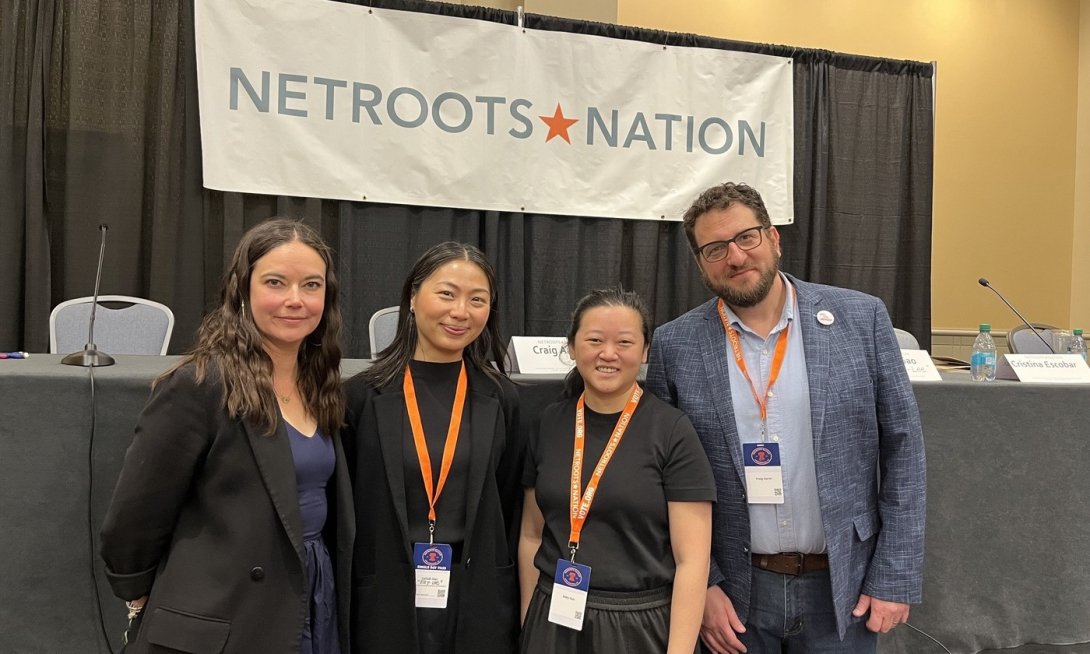
A Netroots panel featuring Free Press’ Cristina Escobar (left) and Craig Aaron (right) with Ceilidh Gao of CWA and Abby Sun of the International Documentary Association underscored the anti-democratic harms of media mergers.
Jonathan Lawson
If you’re like me, you’ve been reading a lot of articles that prominently feature the words “authoritarian playbook.” You might have spotted it in coverage of the news that Trump’s Justice Department has approved Paramount Skydance’s bid to take over Warner Bros. Discovery. The phrase reminds us that what we’re experiencing under Trump has a tested strategy behind it — a pattern anti-democratic leaders use to consolidate power and weaken institutions that could stand in their way.
If you could flip through the authoritarian playbook, you’d see a whole section on capturing the media. And here in the United States, that process has been underway for decades, laying the groundwork for efforts to destroy once-proud institutions like CBS News.
Free Press was founded more than 20 years ago to build a just media system, and we work every day to ensure our information pathways are bolstering our democracy and meeting community needs. Yes, at the federal level, we’re playing defense these days, but that’s not the only place policy is made — and there are beacons of hope all across our movement.
Convening anti-merger activists at Netroots 2026
At the Netroots conference in Philadelphia, I moderated the panel “Media Merger Madness: How to Stop the Right’s Movie and TV Takeover.” In addition to representing Free Press, I was also at Netroots as co-founder and editor-in-chief of Latina Media Co, an indie publication platforming Latina and queer Latinx perspectives in media. As such, I’m deeply concerned about the way media consolidation curtails the ability of women and communities of color to tell their own stories and evaluate them.
The panel discussion featured three experts: Ceilidh Gao, Abby Sun and Craig Aaron. Gao is a senior research associate at the Communications Workers of America (CWA). She came to the panel as a union representative who’s worried about how consolidation is affecting workers. She emphasized the continued importance of broadcast to local news and explained how we can use policy to protect our communities.
The director of programs for the International Documentary Association and a co-founder of the Future Film Coalition, Sun represented creatives during the panel discussion. As she shared during our session, filmmakers looking to distribute their products “have no alternatives that are not controlled by billionaire boutiques,” and that dynamic makes it harder for media workers to make a living and tell the most pressing stories.
Craig Aaron, co-CEO of Free Press, rounded out our group. Bringing the fight for our rights to connect and communicate to the fore, he underscored how detrimental it is to our democracy for the media to be owned by “so few hands they can almost all stand behind the president while he’s being inaugurated.”
Lies and broken promises paved the road here
We are facing two major media mergers. There are the broadcasters, the conglomerates that own your local-TV stations. Nexstar and Tegna are looking to combine into a behemoth that would reach 80 percent of American households and up to three stations in some markets — even though that’s way beyond the federal limits. If this merger goes through, Gao noted, people flipping through the channels might still have “the illusion of different channels and choice” when in reality, “all that content is going to be owned and produced by one company.”
It’s also worth noting, as Gao did, that “Nexstar is actually already a poverty-wage employer.” So if it gets control of even more newsrooms, expect journalism to be even less of a viable career option, despite what the Nexstar lawyers say. “In every Sinclair newsroom and every Nexstar newsroom, there are good journalists … but they’ve been squeezed and squeezed and squeezed over the years,” Aaron said. “When that’s the only game in town, it gives [them] so much more power to dictate the news agenda, to decide what gets covered and what absolutely doesn’t.”
Then there’s the studio side, where Paramount Skydance — itself the product of a mega-merger — cozied up to Trump in its bid to take over Warner Bros. Discovery. The Justice Department approved this dangerous deal on June 12 — and unless state attorneys general succeed in blocking it, the authoritarian-loving Ellison family will control CBS, CNN, HBO, TikTok and many other prominent media properties.
And what does it look like for this family of Trump-friendly billionaires to control news media? We’ve already seen the devastating results at CBS, where Editor-in-Chief Bari Weiss has wrought havoc at 60 Minutes and other news programs, working to turn the network into a MAGA-friendly hub. “It’s spiking stories about people being kidnapped and taken to South America,” Aaron said. “It’s getting rid of correspondents who don’t want to insert Trump-administration viewpoints and misinformation into their reports.”
For her part, Sun told the story of Taxi to the Dark Side, Alex Gibney’s 2007 Oscar-winning documentary about the CIA’s use of torture and interrogation under the George W. Bush administration. The Discovery Channel had purchased the rights, but under David Zaslav’s reign, the network subsequently decided not to air the film because the company wanted to curry favor with the Bush administration. “The company that ended up purchasing it was HBO Documentary Films, which, if the Paramount Skydance-Warner Bros. Discovery merger goes through, will also fall under the control of the Ellisons,” Sun said.
An even more consolidated media system would be a desert for creatives looking to sell their projects to non-billionaire-backed distributors, and one cup of water won’t get us out of it. These deals will remain harmful even if they include concessions to supposedly protect filmmakers, journalists and audiences.
If you’re swayed by promises like the Ellisons’ claim that they won’t interfere with CNN’s editorial independence, just remember Sun’s words of caution: “The promises that have been made to safeguard the work of independent documentaries have not been upheld. Every single promise has been revoked.”
We can’t let this crisis go to waste
“When I started doing this work 20 years ago, I’d go into a newsroom being like, ‘let’s talk about media consolidation.’ They’d be like, ‘meet me in the alley, [because we] can’t be seen talking to you,’” Aaron said. Now, he added, “there’s a completely different awareness among workers in the industry about what the stakes are like.”
And it’s not just journalists — Sun noted how filmmakers haven’t historically been open to being part of the media-justice fight, but that’s changing as billionaires buy up each aspect of Hollywood’s supply chain (did you know the Kushners are the primary investors in “indie” arthouse studio A24?). Even content creators are organizing, Sun said, so that “the future that we’re building, everything that we’re talking about, [can] encompass the ways that we actually view and watch content today.”
Yes, media policy has paved the way for way too much consolidation — and Trump has capitalized on that trend to advance his authoritarian agenda. But we are still fighting, and our coalition is only growing stronger as Trump and his cronies overplay their hand. We are stopping their worst actions now, suing to keep Nexstar and Tegna from merging and demanding state attorneys general block the Paramount-Warner deal.
Eventually, we will have a chance to rebuild our media infrastructure. Part of that involves demanding more funding at the federal level for community-centered media — and building on the success of states such as New Jersey, which are already doing the work.
At that point, Aaron said, “It can’t be about gluing together what we used to have. It didn’t work.” Instead, we need to think about what it means “to actually provide local services and information and really get into creating that diversity of local and competing voices.”
That’s where the answer is. We just have to keep pushing to get there.
Help Free Press keep fighting media consolidation: Donate today.