Building a Bigger Vision for Publicly Funded Media
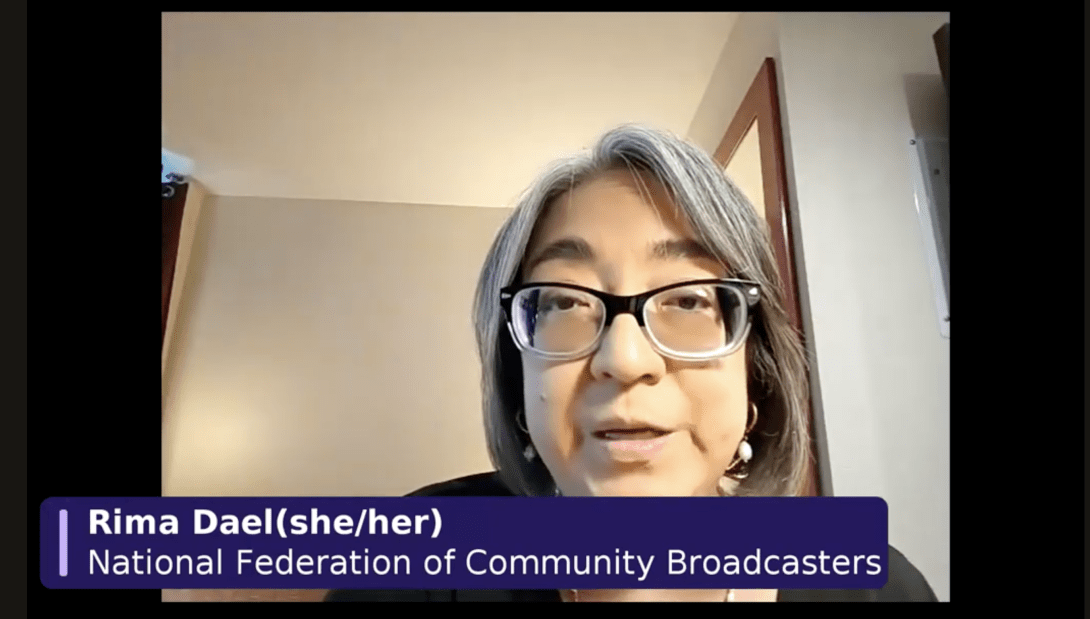
In a webinar about the future of publicly funded media, Rima Dael noted the crucial role that community broadcasters play during disasters, power outages and other crises.
What are the next frontiers for publicly supported media in the United States?
That was the question at the heart of the Media Power Collaborative’s webinar on June 26, which Free Press, the Future Film Coalition, the Institute for Nonprofit News, LION Publishers and the National Federation of Community Broadcasters co-hosted. The conversation brought together leaders from nonprofit news, independent publishing, community broadcasting and documentary film to explore a shared vision for local-media policy change that puts community needs front and center.
The timing is urgent. Across the country, dozens of state and local lawmakers are weighing new ways to support local news and civic information. In the wake of the federal shuttering of the Corporation for Public Broadcasting, these debates are the first steps toward a new kind of public infrastructure for local media — one rooted in community needs, public-interest outcomes and democratic participation.
Unity across the civic-media landscape
As Free Press’ Mike Rispoli noted in his opening remarks, the closure of the Corporation for Public Broadcasting marked “the end of a foundational era” for public media. But the values that have long animated publicly funded media in this country are more critical than ever: universal access, filling news-coverage gaps the commercial market has left behind, and understanding local media as civic infrastructure just like schools or hospitals. This shifts the focus of policy debates, as Rispoli put it, “from industry survival to community service,” and from “subsidies for existing players to public-interest outcomes.”
What made the webinar so powerful was the unity across local-media sectors. INN, LION, NFCB and the Future Film Coalition each represent different parts of the media landscape, but a shared understanding emerged throughout: Nonprofit newsrooms, independent publishers, community-radio stations, filmmakers and local storytellers are all helping people make sense of their communities, build and maintain local identity, hold power accountable and participate in civic life.
Rima Dael of NFCB grounded the conversation in the essential role community broadcasters play, especially in rural, tribal, BIPOC, multilingual and historically marginalized communities. NFCB’s members are often hyperlocal stations operating with tiny budgets and deep volunteer support, providing not just news but music, culture, companionship and emergency communications. During disasters, power outages and other crises, Dael said, community broadcasters are “civic infrastructure for safety across the country.”
Jonathan Kealing of INN emphasized that nonprofit newsrooms “[put] the community back in community journalism” by reporting for and with local residents and centering perspectives that legacy media too often ignore. “If we really think about who it is we’re trying to serve with information,” he said, “we can develop much better policies.”
Chris Krewson of LION Publishers spoke to the danger of policy that reinforces existing media hierarchies, with the largest commercial players dominating debates even as independent community outlets struggle to be heard. He pointed to needs-based public-grantmaking models like the New Jersey Civic Information Consortium, which “put the community at the center of the [funding] decisions.”
Jax Deluca of the Future Film Coalition widened the frame further, making the case that independent filmmakers, distributors, festivals and independent theaters face many of the same pressures as local journalism: market concentration, algorithmic gatekeeping and shrinking distribution pathways. Deluca called for a “Civic Media 2.0” framework that recognizes this expanded field, adding that these problems are “not going to be fixed in silos.”
She also pointed to concrete funding mechanisms worth studying — including Colorado’s Scientific and Cultural Facilities District, a voter-approved, penny-per-$10 sales tax that generated $86 million for arts and culture across the Denver region in 2023 alone — as models for durable, community-governed civic-media funds.
The community and industry imperatives to think big
The central lesson: We cannot build the next generation of public-interest media by asking each sector to fight alone. The future of publicly funded media must be broader than public broadcasting as we’ve known it, and broader than local journalism as an industry category.
Amid immense turmoil for longstanding media-business models — and as communities navigate an ever-uncertain world around them — we need to think expansively about the future of local news. That approach — rather than narrowly preserving legacy-industry models — will be key to the long-term survival of healthy information ecosystems.
There’s a community imperative: People get their news from an ever-widening range of sources, and in a media environment flooded with AI-generated content, stress-inducing national headlines and rampant misinformation, the need for accurate, trusted local information sources has never been greater.
And there’s an industry imperative, too: The one thing every sector can agree on is that no one knows exactly where the local-media industry is headed, or what a sustainable version of it looks like. Meeting that uncertainty means building infrastructure that makes room for all the actors that keep communities informed and connected — whether it’s nonprofit newsrooms, independent publishers, community broadcasters, ethnic media, documentary filmmakers, civic organizations, libraries, educators or artists.
That’s the work ahead for the Media Power Collaborative, and it’s already moving from conversation to action. In states like Massachusetts, Pennsylvania and Wisconsin, MPC members are organizing on the ground at the same moment that policymakers in those states are exploring flexible grantmaking models similar to New Jersey’s Civic Information Consortium. We’re in one of those rare windows where organizing energy, community need and political feasibility are all overlapping — the kind of moment that doesn’t come around twice.
This is bigger than any single sector, any single bill or any single state. It’s a movement to build the next generation of public media in this country. And it’s just getting started.
Watch the webinar below and learn more about the MPC.