Advocacy for Local News Heats up Across Pennsylvania
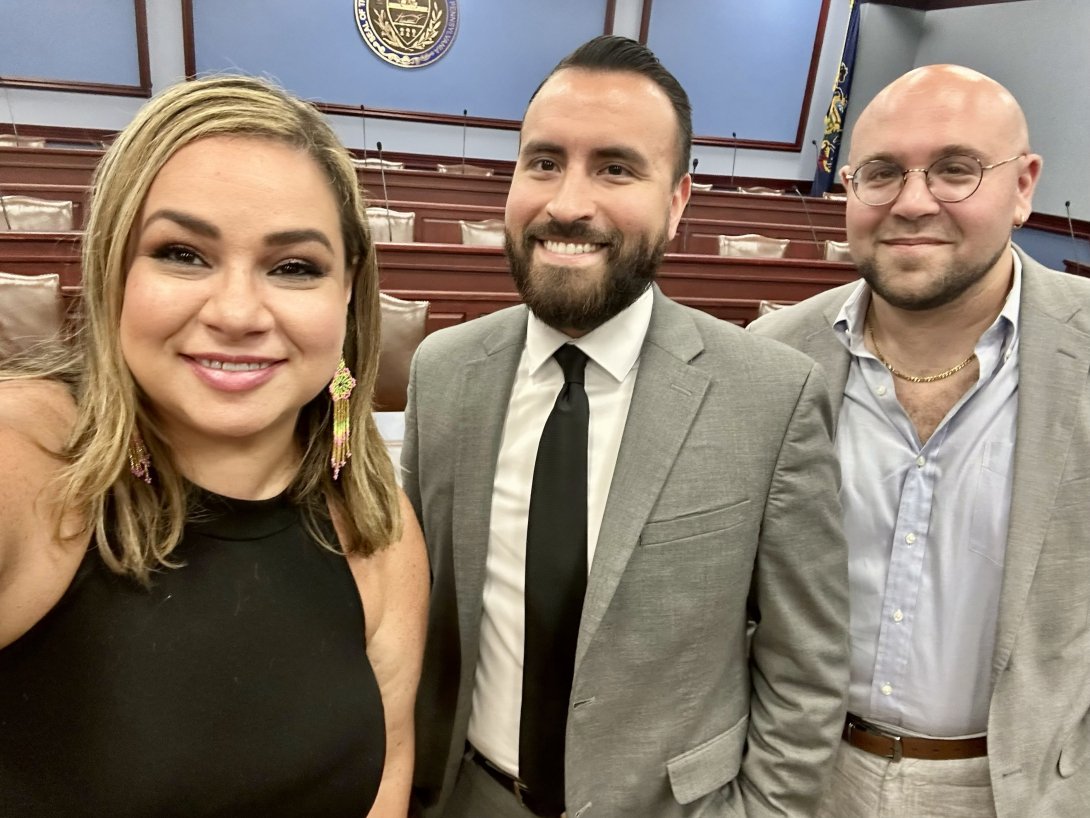
Free Press Action’s Vanessa Maria Graber and Eric Thurm flank Guerrero Lopez (center), the executive director of the Pennsylvania Legislative Latino Caucus
Vanessa Maria Graber
Across Pennsylvania, people struggle to get basic information about issues that are critical to their daily lives.
But everyone has unique information needs. One person might need to know whether there are bus delays and how to access unemployment insurance. Someone else might need to track ICE movements in the area and get updates on local water pollution stemming from abandoned coal mines.
Statewide, certain information needs come up again and again. Real-estate developers and tech companies are flooding Pennsylvania with data centers, but residents don’t even know who’s behind a given development. They don’t know the extent of the potential impact of data centers on their water, their utility bills or the local landscape. And they don’t know where to go to make their voices heard: Zoning and land use can be so opaque that people have no idea who actually has the ability to approve or block a given project.
But data centers are merely one issue residents need more information about. Thousands of people throughout Pennsylvania struggle to access the basic services they expect from their government. Do they have SNAP benefits, and, if so, where can they use them? What about unemployment insurance? If a local hospital closed, where are people supposed to go for treatment? What options do they have if the $20 billion in federal Medicaid cuts for Pennsylvania left them without health insurance? In rural areas, where news outlets are already scarce, many residents lack even reliable broadband service.
That’s why Pennsylvania’s Local News Package is so exciting.
Pennsylvanians want stronger news and information
These two bills, which Rep. Chris Rabb introduced in 2025 — and which passed the Pennsylvania House Committee on Communications in Technology back in February — have the potential to transform the way people across the state get information. HB 2047 would create a fellowship program to place early- and mid-career journalists in community newsrooms, developing a new generation of media workers and positioning them to build trust with the people they cover. HB 2048 would establish a Pennsylvania Information Consortium, an independent body empowered to use public funds to support local news and civic-information projects.
Both bills have a strong precedent, making them an easier sell to legislators. The fellowship program is based on a successful project in California, while the Pennsylvania Civic Information Consortium (PACIC) follows the example of the New Jersey Civic Information Consortium, which since 2021 has awarded $12.5 million in grants that have met the information needs of underserved communities across New Jersey, including rural communities, immigrant communities and communities of color.
The flexibility of the public-grantmaking model means that a PACIC could help guarantee that some Pennsylvanians have better knowledge of data-center projects in their area, while others receive reliable information about acid-mine drainage. That’s part of why a broad coalition including media leaders, civic advocates and researchers have joined together under the umbrella of the Pennsylvania Media Power Collaborative, advocating for the passage of the Local News Package.
On June 10, I traveled to the Pennsylvania statehouse in Harrisburg with my Free Press Action colleague Vanessa Maria Graber to make the case for the Local News Package. First, we briefed several members of the Legislative Latino Caucus as well as members of the Welcoming PA Caucus, which focuses on immigration policy. Vanessa Maria discussed her work as an independent journalist and her organizing with Comunicadores, a collaborative of Spanish-speaking communications professionals in Philadelphia. She also discussed the need for more support for Spanish-language news across Pennsylvania — a need lawmakers recognized.
Throughout the day, we also met with several other members of the legislature to discuss strategy and ask for their continued support for the bills. Everyone we spoke to was universally positive, and excited about the prospect of expanding access to information. Each legislator knew their constituents, and understood what kinds of information they lack.
Local-news policy at INN Days
The following week, I got to discuss the Local News Package with media leaders excited about building stronger systems to better inform communities. Free Press Action Senior Director of Journalism and Civic Information Mike Rispoli and I traveled to Pittsburgh for the INN Days conference, which the Institute for Nonprofit News hosts.
Free Press was everywhere. Mike introduced Rep. Rabb, the sponsor of the Local News Package, for a plenary conversation with INN CEO Karen Rundlet. Rabb’s connection to media policy and serving underinformed communities runs deep — his great-great-grandfather founded the Baltimore Afro-American, and the paper remains within his family. That energy was present in the conversation, in which Rabb called on people who care about local news to advocate for necessary policy interventions — like the Local News Package.
Bright and early the next morning, I set up in one of the event rooms to lead another briefing on the bills, this time focusing on the legislative path forward and how media leaders could get involved. It was before the technical start time for conference programming, but there was still a healthy group gathered. Journalists were excited to learn more about how to advocate for themselves, and for the communities they represent.
Later in the day, I attended a panel about lobbying for journalists — and while the content of the panel was straightforward, the tone was remarkable.
Rather than addressing the question of whether it was acceptable for journalists to have opinions or engage in advocacy, everyone was on board for a conversation about the different types of advocacy, and how to figure out what engagement was comfortable for each individual. I have vivid memories of journalists debating different ideals of “objectivity” dating back more than a decade. Some journalists proudly announce that they don’t even vote, and refuse to discuss politics with their own families. It was refreshing to see how little purchase those ideas have with serious, independent journalists today — journalists who are committed to the communities they serve, and to creating the conditions in which everyone can access the information they need.
And nowhere was that shift more apparent than in our Media Power Collaborative happy hour, which happened at the end of a long day of programming. People from Chicago to Charlottesville to Cape Cod mingled, threw back martinis and discussed their important work — and how they could go even further, with the right resources. As people around Pennsylvania continue to make their voices heard, support for informed communities — and for the Local News Package — will only continue to grow.
Help Free Press Action keep fighting to strengthen local journalism: Donate today.