Trump and Carr See a Propaganda Boost in Getting the Shady Nexstar Deal Done
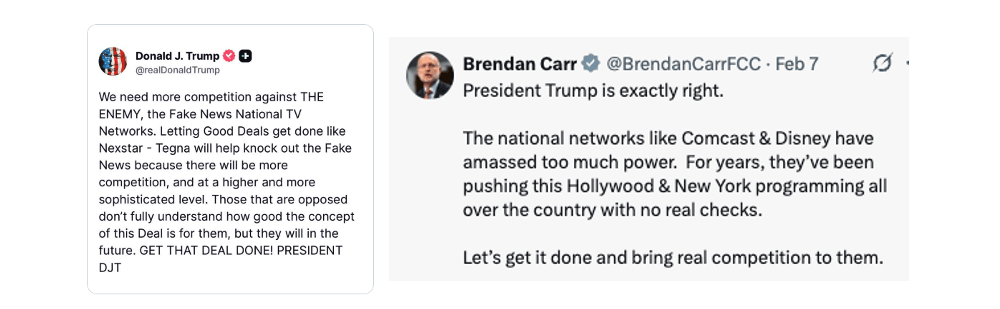
Trump’s social-media rant was more than a nudge and a wink to FCC Chairman Brendan Carr.
On Feb. 7, President Donald Trump threw his considerable heft behind Nexstar’s proposed takeover of Tegna. In doing so, he ignored a broadcast-ownership limit set by Congress, which makes approving a broadcast-industry deal of such massive scale and reach unlawful.
“We need more competition against THE ENEMY, the Fake News National TV Networks,” Trump posted at Truth Social. “Letting Good Deals get done like Nexstar-Tegna will help knock out the Fake News because there will be more competition, and at a higher and more sophisticated level… GET THAT DEAL DONE!”
In Trump-speak, “THE ENEMY” refers to any media conglomerate that doesn’t serve up pro-Trump propaganda. The president’s enemy list includes both Comcast (which owns NBC) and Disney (which owns ABC).
Fox Corporation (which owns FOX) and Paramount Skydance (which owns CBS) aren’t currently on the list, having already caved to the president.
Trump’s social-media rant was more than a nudge and a wink to FCC Chairman Brendan Carr. Carr has spent the past year throwing the agency’s independence out the window, instead favoring unwavering obedience to a president intent on censoring and controlling all U.S. media.
It didn’t take long for a quisling Carr to pledge allegiance to this latest missive from Dear Leader. “President Trump is exactly right,” Carr tweeted within hours of Trump’s post. “The national networks like Comcast & Disney have amassed too much power. For years, they’ve been pushing this Hollywood & New York programming all over the country with no real checks. Let’s get it done and bring real competition to them.”
But there’s a hitch … well, there’s more than just one:
First, this massive broadcast-industry merger is a blatant violation of the law prohibiting one company from too much control over local airwaves.
Second, the notion that media consolidation across the country’s broadcast sector will “knock out Fake News” (Trump) and “bring real competition” (Carr) is so divorced from reality that it deserves its own place on the shelf of Big Lies told by Trump and his lackeys.
Too big to be legal
Trump’s and Carr’s social-media posts come as the Senate is set to convene a Feb. 10 hearing on the FCC’s broadcast-ownership rules. One of the few common-sense media-ownership safeguards still on the books flatly prohibits Nexstar’s proposed takeover of Tegna, which Trump was against before he was suddenly for it.
If approved, the multibillion-dollar deal would combine the nation’s largest television-station conglomerate with its fourth largest. Nexstar controls more than 200 television stations in 116 local U.S. markets. The combined entity would own or operate 265 full-power television stations in 44 states and the District of Columbia, and would be present in 132 of the country’s 210 television Designated Market Areas. The resulting broadcast giant’s reach would be more than twice as large as the 39 percent “National Cap” that Congress set.
Despite what Trump and Carr say, the FCC lacks the authority to approve this merger. Though Nexstar and Tegna are seeking a waiver of this limit, the law prohibits the agency from waiving, altering or eliminating the 39 percent cap. In Free Press’ petition to deny the merger — which we filed alongside allies in labor and civil society — we explain that the FCC “is legally barred from granting applicants’ request to waive the National Multiple Ownership rule.”
“Nexstar has been licking its chops at the prospect of this merger-friendly FCC willing to ignore the law and bend the rules to create a massive broadcast conglomerate,” Free Press Vice President of Policy and General Counsel Matt Wood said at the time. “While Nexstar executives trumpet the so-called synergies of such a merger, we know what that means: newsroom layoffs as the new bosses seek to leverage economies of scale. These cuts come from distant corporate headquarters of companies that are local broadcasters in name only. They lead to less original local news competition, worse coverage, and less viewpoint and ownership diversity.”
Consolidation ≠ competition
That brings us to the second hitch: Broadcast-industry consolidation does not foster competition and independence — quite the opposite. It makes these massive conglomerates easier for Trump and other authoritarian-minded leaders to manipulate.
For a compelling illustration of the many shortcomings of industry consolidation, look no further than Sinclair Broadcast Group, a Baltimore-based broadcast conglomerate that controls licenses to 179 broadcast-TV stations in 81 markets (including those that it operates under so-called shared-services agreements). In 2018, local-news anchors across Sinclair’s national network were forced by corporate headquarters to mouth commentary in support of Trump’s frequent attacks against what he calls “Fake News.” Thankfully, the reporters at Deadspin noticed the mass mimicry and compiled a composite video that one has to see to believe.
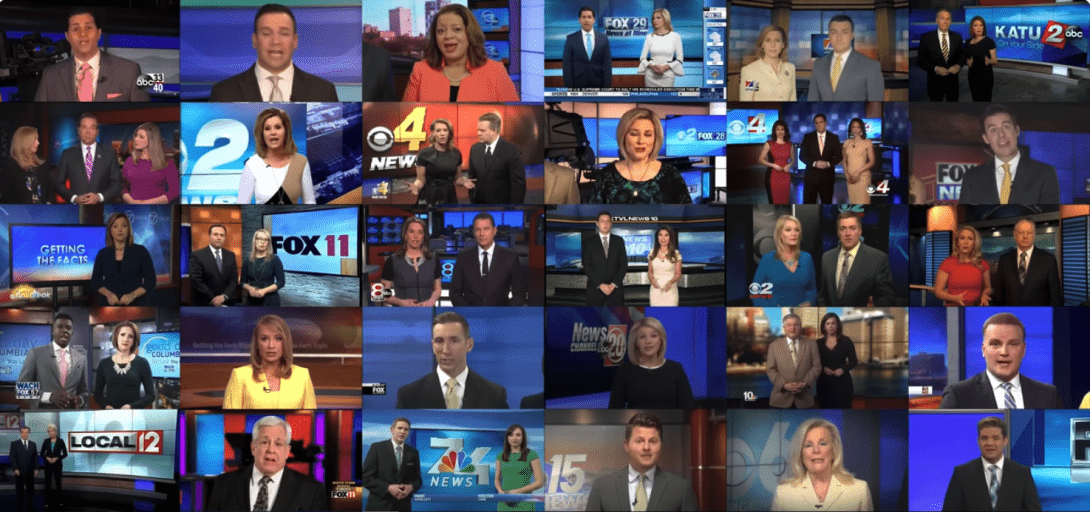
Local anchors nationwide took to the public airwaves to lip sync a Sinclair-provided, White House-friendly script about the perils of fake news, which in Trump’s telling means any entity that questions or challenges his authority. “Our greatest responsibility is to serve our communities,” the local anchors said, adding that they were concerned about the “sharing of biased and false news” on social media, which “controls exactly what people think.”
“This is extremely dangerous to our democracy,” they said in unison.
Indeed. It’s hard to find a more perfectly sinister demonstration of the ways democratic society is harmed by mega media mergers that diminish broadcast competition, undercut localism and decrease viewpoint diversity.
Trump and Carr seek capitulation, not competition
There’s zero evidence to suggest that the creation of huge broadcast-media cartels improves journalism or safeguards a free press. A Free Press analysis of the 35 largest media companies in the United States finds a pervasive pattern of editorial compromise and capitulation as owners of media conglomerates seek Trump administration approval of their plans to become even bigger.
Disney and ABC’s suspension of Jimmy Kimmel Live! following Nexstar’s and Sinclair’s announcements that they would preempt the show in September demonstrate the dangers of media capitulation and consolidated ownership. Nexstar had announced its bid to take over Tegna less than a month earlier, and knew it needed the Trump FCC’s favor to get the deal approved. It quickly bowed to Trump’s fake outrage over Kimmel. This merger — and the steps that companies take to win these goodies from this administration — damage local-television news across the country at a time when the reliability, accuracy and independence of local TV matters more than ever.
We cover this in much more detail in Free Press’ Quadrennial Review filing to the FCC, which includes references to an American Economic Journal finding that when a media conglomerate like Sinclair takes over a locally owned affiliate, coverage of police misconduct declines while segments mentioning immigrants in relation to crimes increases.
To claim that a bigger Nexstar would compete with the likes of Comcast-owned NBC makes zero sense. Local-television stations don’t compete with national affiliates. Local television needs popular national sports programming to lead into their popular local-news broadcasts. The national networks in turn need the local outlets to reach audiences.
“The entire notion that national-scale Nexstar and Sinclair will compete against the very networks that they choose to affiliate with and very much need is nonsensical,” said S. Derek Turner, the senior economic and policy advisor at Free Press. “This is ultimately driven by Trump’s grievances against late-night comedians on ABC and NBC. That explains why Chairman Carr only ever mentions Disney and Comcast as threats to the public interest. Fox and CBS don’t come up at all in Trump’s and Carr’s rants, which are completely devoid of any serious analysis of how broadcast law and policies actually impact competition.”
Furthermore, neither Nexstar nor Sinclair are truly local. They’re enormous national corporations based in Irving, Texas, and Baltimore, Maryland, respectively. They own and control hundreds of local stations, overriding the editorial choices of newsrooms and the programming decisions of stations in the communities that they claim to serve. Does anyone really believe that when Nexstar and Sinclair preempted Kimmel in Washington, D.C., or in Seattle, they were reflecting the values of those communities? Of course not.
Carr and Trump are just picking favorites, doing special favors for media giants that have already capitulated to Trump’s political agenda at the expense of those that have yet to bend a knee.
Help Free Press keep fighting media consolidation: Donate today.