To Pass Legislation, Wisconsin Journalists and Media Leaders Are Getting Organized
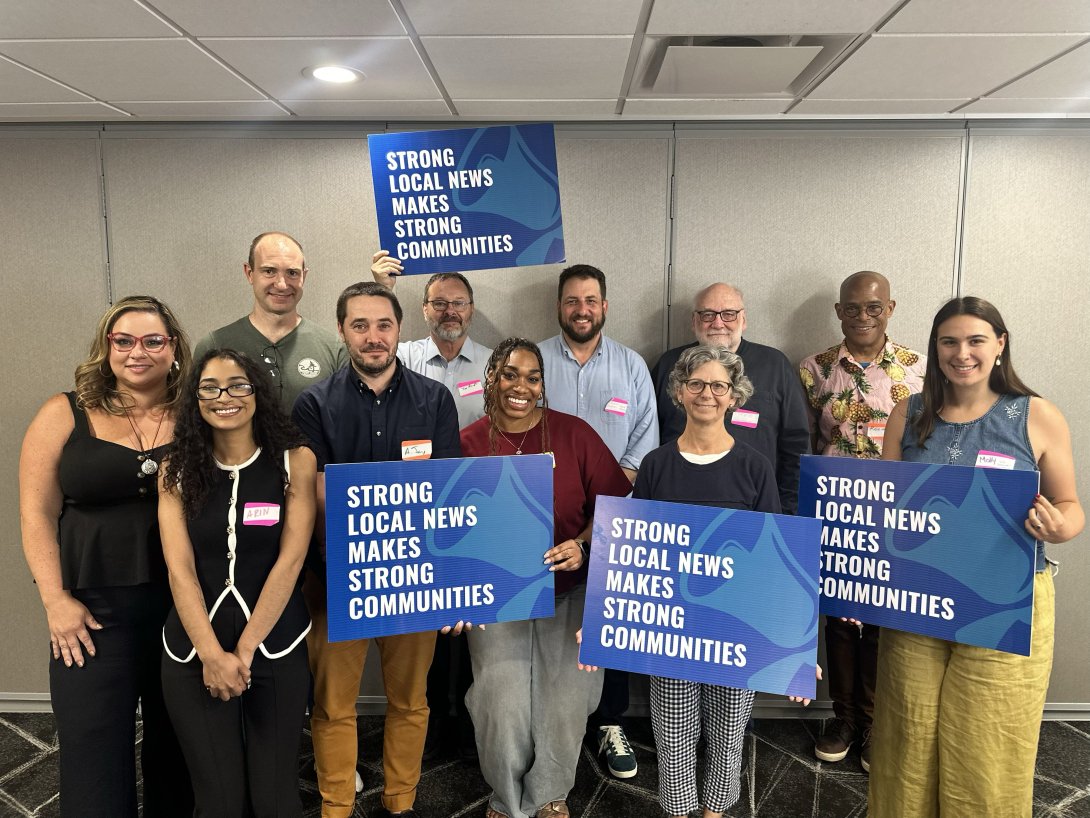
Free Press Action’s Vanessa Maria Graber and Arin Anderson (first and second on left) and Craig Aaron (center of back row) with allies in Wisconsin
If you’ve been in Milwaukee long enough, you know the summers are filled with activities, festivals, youth programs, community projects and so much more.
Seeing all the buzz around the city reminded me how important it is for people to have access to information about what’s happening in their communities — whether that’s a block party or an urgent matter that residents need to know about, like the smoke from Canadian wildfires affecting the air quality for days in mid-July. I’ve seen firsthand how people struggle to know what’s going on and don’t know exactly where to go to find the information they need.
Oftentimes we just use social media or ask around to find out what’s happening in our communities. We look to Facebook for information about the data center proposed for Midtown Shopping Center in Milwaukee and check Instagram for updates on local ICE activity. That’s not because journalists aren’t reporting on these issues. Journalists are working hard to cover these breaking stories, but they don’t always have the resources and support they need to do their jobs without facing risks to their safety, their newsrooms and their coverage. Like organizers, journalists are on the frontlines working tirelessly to cover stories and share the information community members need and deserve.
That’s why journalists need elected officials to pass legislation that safeguards and supports their work. For example, Wisconsin has no anti-SLAPP legislation protecting journalists and ordinary community members from costly lawsuits as a threat against free speech and press freedom. Local newsrooms also face a lack of funding and staffing that makes it harder for people to do their jobs. In the last legislative session, Wisconsin lawmakers worked to address both of these issues by introducing anti-SLAPP legislation, which passed the assembly with bipartisan support. And in March, two lawmakers introduced a package of bills to strengthen local news and civic information across the state.
Lawmakers are showing up to support community-rooted news and information
It’s clear that there is support from lawmakers on both sides of the aisle for local news, free speech and informed communities — and multiple offices have told us that they’ll be pushing hard to pass all of these bills when the next legislative session convenes in early 2027. A robust coalition has emerged behind the anti-SLAPP bill in particular, giving it the backbone it needs to pass.
While the 2026 legislative session ended in March, our work hasn’t stopped — nor has the conversation around strengthening and supporting local news and informed communities across Wisconsin. In fact, it’s grown.
Since March, I’ve been talking with journalists and community members about the information needs of towns and cities across Wisconsin. I’ve also learned about the different media leaders and newsrooms serving people in various parts of the state. Over this time, I’ve had countless conversations and have learned a lot about how information flows through different communities, what residents want more information about, what newsrooms need to do their work, and how outlets are working to adapt to their audiences and find new ways to reach and engage them.
Media leaders, newsrooms and journalists discuss how they can work together
With a common goal of keeping Wisconsin residents informed through access to trusted, reliable and community-rooted local news — and with a window of opportunity ahead of us — Free Press Action knew that if we wanted to make real change, we had to get organized. So, we decided to gather in person to start shaping a vision for what this change looks like.
With support from Free Press Action’s Craig Aaron and Vanessa Maria Graber, in late June I convened a group of 10 newsroom leaders, community leaders and journalists for a strategy roundtable in Madison. Representatives from outlets from across the state took part, including the Isthmus, Milwaukee Courier, Vernon Reporter and Wisconsin Watch.
During this discussion, we talked through what a robust civic-media landscape would look like in Wisconsin — and what change is necessary to get there. We discussed what core values should be at the center of any legislative proposal, what communities we’re serving and centering, and what’s possible with the opportunities ahead of us.
In the end, we landed on some shared values, policy pillars that reflect those values and potential vehicles to drive the change we hope to see.
Local news and information should be treated as public goods
We agreed that journalists should be safe and protected, and that local news and information should be treated as essential civic infrastructure like schools or hospitals. We also agreed that there should be proactive investment in underserved communities.
In addition, there should be diversity among newsroom staff, and a focus on serving diverse audiences. The types of media coverage should also be diverse, ensuring information is accessible, digestible and relevant to individual communities.
We also discussed the need for active collaboration among newsrooms, journalists, community members and civic organizations. We should be partners collaborating on what stories to cover and on new ways to engage with readers. Journalists shouldn’t be strangers in the communities they serve — and outlets shouldn’t treat readers simply as an audience.
We had a good understanding of our shared values, but we needed to translate those values into policy pillars that any policy design should center. When we thought about these policy pillars, we also wanted to envision what they actually looked like. So we wrote out each pillar on a giant notepad, stuck the pieces of paper on the walls, and went around with our Post-its and pens, scribbling all of our ideas onto these tiny squares and sticking them up on each sheet. Then we talked through each pillar, every Post-it and a plethora of ideas. We landed on a few things.
We want to ensure any policy change focuses on stabilizing and strengthening the local-media ecosystem and investing in local civic infrastructure. We also want any policy change to center historically underserved communities — and to protect free expression, safeguard press freedom and ensure public transparency. Once we landed on these principles, we had to figure out what legislative vehicles can achieve our goals while also centering these shared values. We discussed what that could look like in Wisconsin — and what’s actually possible given the state’s political landscape.
Throughout this discussion, we learned that despite the efforts of hardworking journalists across the state — including many of the folks in the room — the Wisconsin local-news landscape is in dire need of support and funding. The groups that gathered with us are looking to collaborate, organize, build community and advocate for change. However, they often lack the resources to foster more collaboration — revealing a need for policy that will foster long-term sustainability.
Any policy must center community members’ needs
This roundtable discussion is just the beginning — there is still so much work to be done. That’s why we’re going to continue the work, continue the conversation and continue to organize and grow the support needed to see real change happen.
Now that we’ve started building this core vision among newsrooms, media leaders and journalists, we want to hear directly from community members. We can’t advocate for people unless they tell us what they need. That’s why we’ll be hosting our first community-listening session in Milwaukee on Sun., Aug. 2. If you’re in the Milwaukee area and are interested in attending, RSVP to join us.
We have so much more in store, and with this foundation, we’ll be prepared to go into the 2027 legislative session with a more organized, unified coalition to advance the local news and information Wisconsinites need and deserve.
Help Free Press Action keep fighting to keep local communities informed: Donate today.