Q&A with FCC Commissioner Anna Gomez
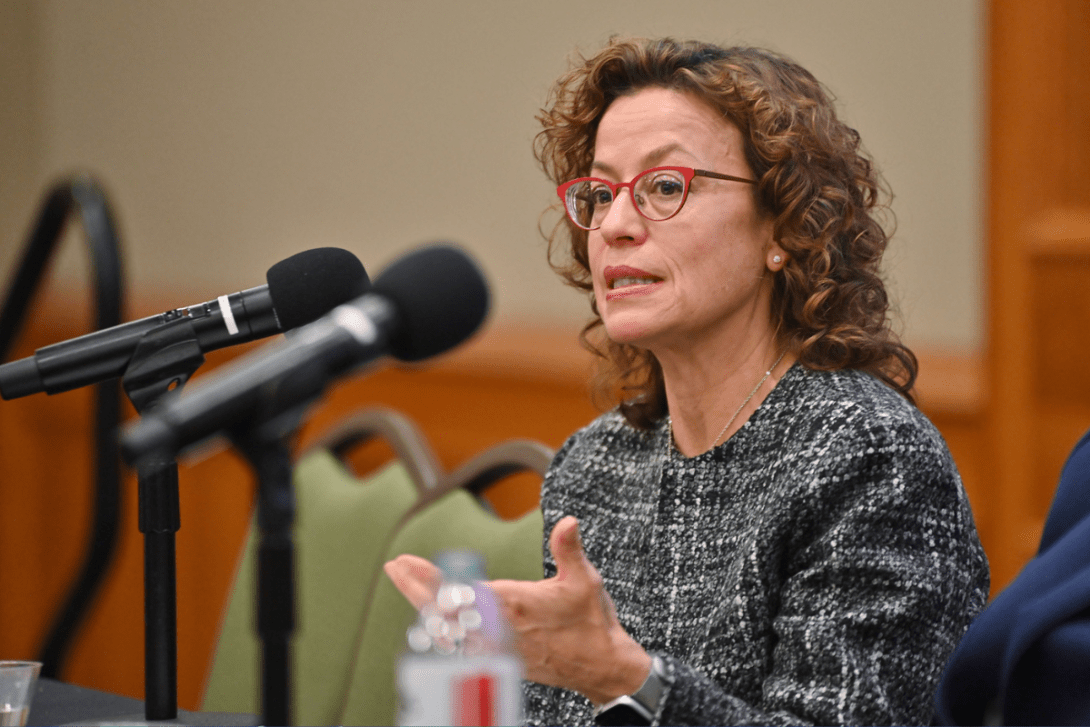
In response to FCC Chairman Brendan Carr’s abuses, FCC Commissioner Gomez has stood out as a fierce free-speech defender and truth-teller.
Jesus Rincon
This isn’t what Anna Gomez signed up for. A longtime communications lawyer and FCC insider, the agency’s lone Democratic commissioner got the job because of her deep subject-matter expertise.
But under the Trump regime, the assignment has changed.
Trump FCC Chairman Brendan Carr has weaponized the agency, shaking down merger-seeking companies, launching bogus investigations into news content, attacking diversity programs and pushing the agency into the middle of the culture wars. Most recently, Carr threatened late-night and daytime-TV talk shows for allegedly violating the agency’s equal-time rules by interviewing administration opponents and critics.
In response, Gomez has stood out as a fierce free-speech defender and truth-teller, calling out the agency’s overreaches and exposing its sham legal arguments. In the face of Carr’s cartoonish bombast, Gomez is always calm and collected. But while many political leaders have cowered or equivocated in this moment, Gomez has been a model of principled opposition.
To better understand how she does it — and to make better sense of the FCC’s latest attacks on free speech and press freedom — I interviewed Commissioner Gomez via email after the FCC’s January open meeting.
The FCC is again threatening TV talk-show hosts. What is happening, and why do you think it’s happening?
Here’s the thing people need to know right away: Nothing has fundamentally changed in the law.
The FCC hasn’t adopted a new rule. It hasn’t reinterpreted the statute. And it hasn’t voted to roll back the long-standing news exemptions broadcasters have relied on for decades.
For years, the Commission has been very clear that bona fide news interviews, including late-night and daytime programs, are entitled to editorial discretion. Those decisions are supposed to be driven by newsworthiness, not politics. That hasn’t been repealed or revised. And it applies to all broadcasters — television and radio alike — whether coverage is friendly to this administration or critical of it.
So this isn’t really about a change in the law. It’s about how the law is being talked about.
The recent guidance from the FCC was framed as a reminder, but in practice it functioned as a warning, especially to shows that report the news or push back against this administration. And while that guidance didn’t change broadcasters’ rights or obligations, it was still a threat.
And that’s the problem. The threat is the point. When a regulator hints that certain coverage could bring consequences, it creates fear and uncertainty, even if no rule is ever enforced. That’s why we can’t give these threats power they don’t actually have.
The First Amendment doesn’t disappear just because the government is unhappy with how the administration is being covered. Broadcasters have a constitutional right to air newsworthy content, even when it’s critical of those in power. That’s true today, it will be true tomorrow, and it doesn’t change simply because this administration would prefer less scrutiny.
“Equal time” sounds fair on its face. How are the equal-time rules actually supposed to work, and is what the FCC is doing legal?
This is one of those phrases that sounds straightforward but really isn’t. What people usually call “equal time” is actually about equal opportunities, and it’s a much narrower rule than most people realize.
At its core, it applies only when a broadcast station gives a legally qualified candidate a “use” of its airwaves during a narrow window of time prior to an election. Even then, it doesn’t require identical airtime or perfectly balanced coverage. It just requires a comparable opportunity.
Another important piece often gets missed. It is up to the candidate to request that time. While stations do have to publicly disclose when a candidate uses their airwaves, they are not required to invite these candidates on or offer them airtime, even though many choose to do so. And the FCC has no role at all unless and until the candidate and the broadcaster are unable to reach an agreement. Only a legally qualified candidate can ask the FCC to step in. Complaints from partisan organizations have no standing under the law.
That’s why it’s been puzzling to see a complaint from a partisan group remain open following the Saturday Night Live appearance by Vice President Kamala Harris in 2024. No violation occurred because the Trump campaign reached a satisfactory agreement with the network. Under the law, that should have been the end of it.
And here’s the part that really matters. Congress was clear that these rules were never meant to interfere with journalism. That’s why there are long-standing exemptions for bona fide newscasts and bona fide news interviews. Without those exemptions, the government would be deciding which interviews count as journalism and which don’t, and that’s not the FCC’s role.
Another thing that often gets left out of this discussion is that these rules apply to all broadcasters, television and radio alike. And they’re supposed to be applied evenly, whether coverage is friendly to this administration or sharply critical of it.
So, when people hear claims that “the rules require this” or “the law demands that,” it’s worth slowing down and looking at what the law actually says. The FCC hasn’t changed the rule. It hasn’t voted to narrow the exemptions. The framework is exactly what it has been for decades, and it’s designed to protect editorial independence, not undermine it.
You say “the threat is the point” — that even without rule changes, there’s a chilling effect.
Yes, absolutely. And it’s important to understand that you don’t need a new rule or a formal enforcement action for a chilling effect to take hold.
When a regulator publicly suggests that certain coverage could trigger scrutiny or consequences, people start to hesitate. Executives and producers begin asking themselves whether a segment is worth the risk, whether a guest is worth the hassle, or whether it’s safer to steer clear altogether. Over time, that hesitation shapes coverage.
The law hasn’t changed. Broadcasters’ rights haven’t changed. But when the FCC signals that it’s willing to blur the line between oversight and retaliation, it creates exactly the kind of chilling effect the First Amendment is meant to prevent. And it’s working. I’ve heard from many broadcasters who tell me they’re concerned about repercussions from the stories they want to pursue and the way they may cover this administration.
That’s why it’s so important not to give these threats more power than they actually have. The moment fear starts driving editorial decisions, the public loses.
Media companies have changed their practices under pressure — killing stories, adding “bias monitors,” abandoning diversity efforts. How should they respond?
I understand the pressure these companies are under, but I don’t think accepting censorship as the cost of doing business is the right answer.
Once you start making quiet concessions, the line doesn’t hold. It moves. And pretty soon, decisions aren’t being driven by journalism or values, but by fear of retaliation. That’s not healthy for the press, and it’s not healthy for the public.
My message to broadcasters is simple: Don’t be cowed. Don’t stop doing independent reporting on what’s happening in this country just because you’re worried about drawing attention from Washington. Broadcasters have constitutional rights, and those rights don’t disappear because coverage is uncomfortable or critical of this administration.
Transparency also matters. If companies are feeling pressure from the government, the public should know. Sunlight makes it much harder for intimidation to work in the shadows.
At the end of the day, independent journalism isn’t just a business choice. It’s about maintaining the public’s trust. And protecting that trust means finding the courage to keep doing your jobs, even when there’s pressure not to.
You spent much of the last year traveling the country talking about free speech. What did you hear, and what does Washington need to understand?
Over the past year, I’ve watched the FCC take a markedly different approach than the one people expect from an independent regulator — one that has undermined its reputation as a stable, expert-driven agency. And nowhere is that departure more troubling than in efforts to intimidate critics, pressure media companies and test the boundaries of the First Amendment.
That concern is exactly why I launched a First Amendment Tour last year. I traveled across the country to communities in Mississippi, Kentucky, Florida, Illinois, Maryland, Washington State, New York, Connecticut, New Jersey and California. And I had a simple goal: to listen, to engage, and to reaffirm that the FCC’s work must remain grounded in constitutional principles and public trust.
What I heard was consistent and deeply concerning. Broadcasters told me they are thinking twice about coverage that is critical of this administration out of fear of regulatory scrutiny. That hesitation alone should give us pause.
People were also very clear about something else: Free speech isn’t just a talking point to them. It’s how they hold powerful institutions accountable. When they see the government pressuring journalists or broadcasters, they worry about whether they’re getting the full picture of what’s really happening, both nationally and in their own communities.
What stood out to me most is that these concerns cut across ideology. I found myself aligned with voices from across the political spectrum. We were united by a shared belief that the First Amendment is fundamental to our democracy and worth defending, even when doing so is politically inconvenient.
That’s the message my colleagues at the FCC need to hear: Independence matters. Trust matters. And once those are lost, they are very hard to rebuild.
So many people mobilized when FCC pressure led local stations to pull Jimmy Kimmel off the air last fall. What should people be doing now?
What we saw in that moment was that public engagement matters. When people paid attention, spoke up and made their voices heard, it changed the dynamic. It showed broadcasters that they weren’t alone, and it showed regulators that these actions don’t happen in a vacuum.
The most important thing people can do now is stay engaged. Support local stations and journalists when they’re under pressure. Let them know you value independent reporting and expect editorial decisions to be driven by newsworthiness, not fear.
It also means calling this behavior what it is. Informal threats and pressure campaigns are still censorship, even when they don’t come wrapped in a formal rule or enforcement action. The more sunlight there is, the harder it becomes for intimidation to work quietly.
Ultimately, this stops when we collectively refuse to normalize it. A free press doesn’t protect itself automatically. It depends on an informed public that’s willing to speak up when government pressure crosses the line.
Are there other FCC actions flying under the radar that the public should be concerned about?
What worries me most right now is not just what the FCC is doing, but what it’s not doing.
When I came to the Commission, my priorities were straightforward and bipartisan: making sure people can afford broadband, expanding reliable connectivity, protecting consumers, preserving local media and ensuring public-safety communications actually work when they’re needed. Those are the issues people expect the FCC to be focused on. Instead, over the past year, the agency’s energy has been directed elsewhere, often toward culture-war fights that don’t lower bills or improve service for everyday consumers.
And when the FCC loses focus, consumers pay the price. We see it in higher costs, fewer choices and missed opportunities to close real gaps in access and affordability.
Take affordability. After the Affordable Connectivity Program lapsed, millions of households saw their broadband bills go up overnight. That should have triggered urgent action. Instead, there’s been very little focus on consumer relief at a time when cost is one of the biggest barriers to staying connected.
At the same time, the Commission has retreated from practical, consumer-focused initiatives that were actually making a difference. It eliminated E-Rate support for school-bus connectivity and hotspot lending, rolled back limits on excessive prison-phone rates, proposed weakening broadband-nutrition labels that helped people understand what they were paying for, stalled work on the Cybersecurity Trust Mark and delayed efforts to deliver improved multilingual emergency alerts. Not to mention the recently announced effort to reduce legitimate participation in the Lifeline program.
None of those initiatives were symbolic. They were designed to make communications more affordable, more transparent, more secure and more accessible. Rolling them back or letting them stall sends a clear message about priorities, and it’s not one that puts consumers first.
That’s why I keep coming back to this point: We should measure success in human outcomes, not dollars spent or deployment statistics. Who is actually connected? Who can afford to stay connected? Who is protected, informed and included?
The FCC does its best work when it honors the people it serves. When it focuses on lowering costs, expanding opportunity and protecting consumers, it earns public trust. That’s the mission I believe the Commission needs to return to, and it’s what people across the country are asking for when they talk to me about what really matters in their lives.
You’re one of the few Democratic independent regulators still in office. Are you worried about your job? What keeps you going?
I’m realistic about the moment we’re in, but I didn’t take this job expecting it to be easy or comfortable. I took it because I believe deeply in what an independent FCC is supposed to be, and in who it’s supposed to serve.
What keeps me going is the responsibility that comes with this role. The FCC doesn’t exist to advance political agendas. It exists to serve the public, to protect consumers and to safeguard the principles that allow people to communicate freely and stay connected. When those principles are under strain, it matters that someone is willing to speak up from the inside.
I also think a lot about the people I’ve met across the country. Broadcasters who are worried about doing their jobs. Families struggling to afford basic connectivity. Communities that rely on trustworthy information in moments of crisis. Walking away from this work would feel like walking away from them.
So no, I don’t come in every day because it’s easy. I come in because independence matters. Because trust matters. And because these institutions only work if the people inside them are willing to stand up for what they’re supposed to be, even when that’s politically inconvenient.
This piece previously appeared in the Free Press newsletter Pressing Issues.