Free Press Comunicadores Project Supports Spanish-Speaking Journalists and Media Workers
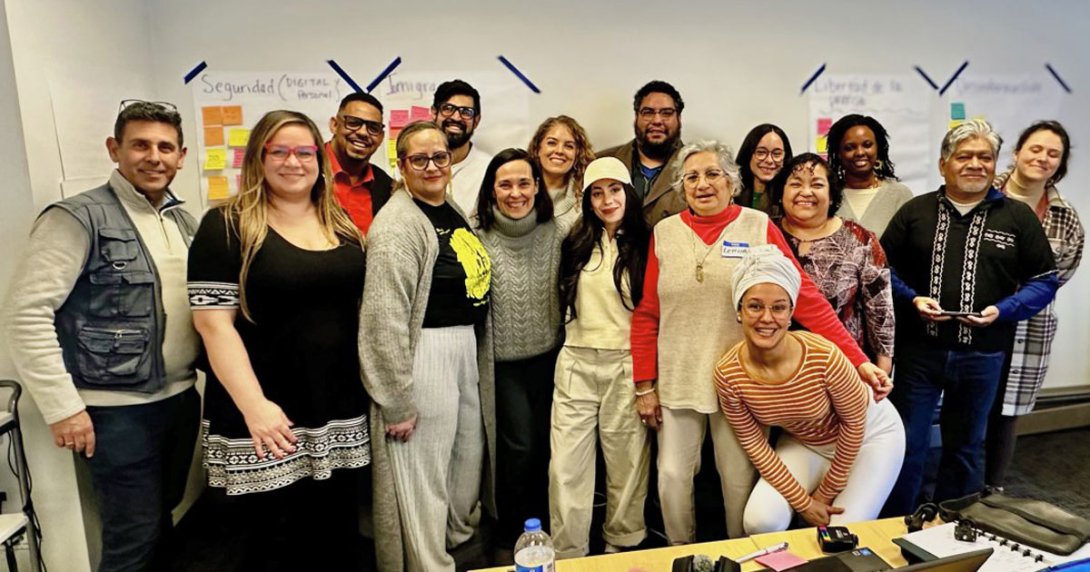
Comunicadores met over the winter in Philadelphia to discuss the challenges Spanish-speaking media workers face and what more can be done to support their vital work.
“How do we achieve true language justice for our communities?”
According to the latest Census survey, almost 45 million people in the United States, as well as an additional three million people in Puerto Rico, speak Spanish at home. As that number continues to grow, more and more communities need access to culturally relevant local news and civic information in Spanish.
Responding to that need is a growing community of journalists, media workers and communicators in the United States and Puerto Rico who are working to provide critical news and information in Spanish to Latiné and Hispanic communities.
These information stewards, who represent a diversity of media outlets from large, broadcast Spanish-language TV networks to small, hyperlocal community media outlets, are reporting on important issues like immigration law enforcement, government corruption, domestic violence, how to access public resources and many other civic issues.
In many cases, they are communicating outside the parameters of traditional journalism, using social media and platforms like WhatsApp to deliver content where their communities are. Some are podcasters, live streamers and newsletter editors, while others are professional journalists with many years of experience reporting for prominent news outlets in their home country.
Despite the vital role they play in local and national media ecosystems, there is little institutional support for them from journalism organizations, funders or universities. As a result, they disproportionately lack access to culturally relevant training, education and resources available in Spanish that can assist them in doing their job and help keep them safe.
The information gap
As a former chapter president of National Association of Hispanic Journalists (NAHJ) Philly, and a bilingual journalist in Philadelphia, I saw firsthand how a lack of access to resources can impact my colleagues and friends who are Spanish speakers. When ICE detentions escalated and immigration policy rapidly changed, many communicators struggled to get the information out.
Many of us had questions about our rights to free speech and how we could access legal support after seeing the arrests of journalists like Mario Guevara, Georgia Fort, Don Lemon, and most recently, Estefany Rodríguez.
Even though I was seeing these conversations in chat groups at the local level, I wasn’t sure if this information gap was widespread. That’s why I set out to engage Spanish-speaking journalists and media workers in other parts of the United States and in Puerto Rico to better understand the challenges they face while providing critical information to communities most impacted by the escalated attacks on immigrants and the press.
Finding power in solidarity
Last year, I participated in the MacArthur Foundation’s gathering of Latino newsroom leaders at a pre-conference session held in Chicago ahead of the NAHJ annual convention. The half-day session was held entirely in Spanish and it was one of the rare times I got to convene with my peers to talk about the issues that matter to us.
That convening affirmed our earlier assessment: Spanish-speaking journalists were facing increased risks to their safety and freedom of speech, combatting an onslaught of disinformation being spread online and dealing with the mental health impact of covering violent immigration law enforcement operations.
Similar to my colleagues in Philadelphia, I learned that newsroom leaders had little support despite the increased risks and unique threats they were facing. They also had a need for more conversation, more training and more legal support for their organizations. Latiné newsroom leaders also grappled with sustainability.
Everyone talked about the limited amount of funding for ethnic media. Although the group identified many challenges, participants recognized the power of coming together and having a safe space to talk about the current crisis we were collectively experiencing.
Creating Communicadores
I returned home to Philadelphia with more insights on how to bring together local Spanish-speaking Latiné and Hispanic newsroom leaders, journalists, content creators and producers to continue the conversation. I met with allies at PhillyCAM, El Centro Integral de la Mujer Madre Tierra, and Temple University’s Center for Community-Engaged Media to see if there was interest in working together to unite this community of “comunicadores.”
These organizations all have significant experience in facilitating education, community engagement, cultural competency, DEI and collaboration. They also valued the role the ethnic media plays in meeting the information needs of Spanish-speakers in the greater Philadelphia area. We discussed working together to build relationships and trust with Spanish-speaking journalists and media workers. And we could leverage our resources to support their professional development and build infrastructure for mutual aid.
Together we created an outreach list and began having one-on-one meetings with our colleagues gauging support for a new collaborative effort. We found almost everyone we talked to enthusiastically supported a space for Spanish-speakers to gather and collaborate.
That is how our Comunicadores initiative started. Thanks to the support of the People’s Media Fund, we were able to pilot our idea over the last nine months.
Building infrastructure
Free Press held four convenings over the past year with Spanish-speaking journalists and media workers to document what this community was experiencing. Last summer, together with our partners, we organized a digital security workshop in Spanish with the International Women’s Media Foundation. Over the summer and fall, I had one-on-one conversations with dozens of Latiné colleagues and friends who worked in the fields of journalism and communications, and I attended scores of events in the Latiné community in Philadelphia asking the same question, “What information do you need?” Those conversations with community leaders and “comunicadores” in my community informed the topics that we picked to frame the conversation for our first convenings.
In the winter, we held two Comunicadores organizing meetings in Philadelphia. And at the Online News Association Summit in Chicago, Free Press facilitated a Spanish Speakers meetup. We also distributed two online surveys in Spanish to Latiné journalists and media workers in Philadelphia and in other parts of the U.S. and Puerto Rico asking them about the challenges they face and what could organizations like ours do to support their work?
At our Philly Comunicadores meetings, participants expressed gratitude for convening in person and shared that a project like this was long overdue. This project is the first time ever that these “communicators” had been organized into a community event together.
The relationships and trust built between Communicadores members has been the pilot’s biggest impact thus far. Where local Spanish-speaking journalists and creators were previously going at it alone, they now have access to a network of peers learning and organizing together in a Spanish-first environment that prioritizes their communities’ information needs. We’re networked through monthly meetings, an email list, and a WhatsApp chat group. With every email update, we send digital resources in Spanish, and recaps of the conversations we’ve had. We’ve been able to map out a schedule of training for the spring, create a list of online resources in Spanish, and establish the ways the group wants to collaborate.
The connections built by Communicadores have an outsized positive impact on small and independent publications that have little to no administrative or legal support. Particularly as it relates to challenges with immigration enforcement and First Amendment protections, Spanish-speaking journalists from small publications expressed great relief at having a trusted community to ask questions, get connected to resources, and plan for how to share that information widely.
Here’s what we learned:
Many of the journalism resources and professional development offerings are designed for a media system that is English-speaking and are not adapted for media organizations serving Latiné immigrant communities in Spanish. They are often not culturally relevant or made with the unique context in which Latiné newsrooms are operating within their respective communities.
Another challenge identified by Latiné newsroom leaders is that there is little infrastructure to facilitate collaboration with other members of the Latiné media so they can share resources, content, learnings and tools. The overwhelming majority of collaborative journalism projects are facilitated in English. Many newsroom leaders feel a desire for connection and solidarity with other Latinés doing similar work who understand the cultural differences from English-dominated media. They need spaces where they can convene, strategize and build power.
Apart from education and connection with their peers, Latiné newsroom leaders also feel there is a lack of equity, access and representation in philanthropy. Even though some are the recipients of grant funding, many more Latiné newsrooms have not been able to access these resources. This is because grant applications are English and there’s often a fundamental misunderstanding of how Spanish language media functions in their communities.
Latiné newsroom leaders also want to have a seat at the table in conversations about public funding for local news and be able to advocate for their communities. Because there is still such an urgent need for newsrooms to serve Spanish speakers, philanthropic, academic and technological institutions need to understand that producing journalism in Spanish is part of guaranteeing the right to information in the United States. Latiné newsroom leaders need more access to resources and more visibility of their work in these spaces.
Latiné media workers and journalists (English and Spanish speaking) shared an overwhelming sense of concern for their personal safety and need for more resources when it comes to reporting on immigration.
This ranged from wanting policy briefings on the changing landscape of immigration status to how to safely report on ICE raids and immigration detention centers. Comunicadores also wanted to discuss the mental health impact of escalated ICE arrests and deportations, acknowledging the widespread fear, anxiety and depression being experienced by immigrant communities. Knowing a high number of immigrants lack access to mental health resources, they pondered, how could journalism be a vehicle to spread awareness and help?
Achieving ‘language justice’
Across these convenings, Comunicadores also talked about how widespread disinformation and AI-generated content was proliferating on platforms like YouTube, WhatsApp and Facebook groups. They wanted more resources around combatting disinformation, especially disinformation that comes from Latin America, and how to verify local rumors about ICE.
They also expressed concern about privacy, surveillance and intellectual property. They wanted to understand how tech platforms use their data and journalistic content for AI learning models and/or are sharing the data with the government for surveillance purposes. Many felt they were more vulnerable to surveillance if they were reporting on ICE activity and government corruption.
At ONA’s annual convention in Chicago, journalists wanted to see more conversations about current events and issues affecting their daily lives including more workshops in Spanish geared toward reporters, and meetups for specific beats like investigative reporting and food and culture. Journalists from Puerto Rico talked about the impacts of repressive laws and policies recently enacted in the archipelago that restricted their access to public records, meetings, and credentials for the press.
They were regularly denied interviews and access to public officials which made it more difficult to do civic and accountability journalism. Similarly, reporters who covered immigration detailed the difficulty in accessing public records from the Department of Homeland Security, ICE and immigrant detention centers. Another participant talked about the need for more resources and discussion on covering the epidemic of domestic violence and femicide, which remains one of the most underreported issues affecting the Latin American diaspora.
On a more positive note, they talked about successes they had working with content creators, using social media and vertical video more to reach Spanish-speaking audiences and creative ways to get out the story beyond their digital platforms. The conversation ended with a participant asking, “How do we achieve true language justice for our communities?”
That’s the question we’re trying to answer through this project.
Polling Spanish speakers
In the coming months, we’re partnering with the International Women’s Media Foundation to host more safety trainings, collaborating with Factchequeado to offer verification and fact-checking training, assembling an immigration policy briefing with attorneys and experts on immigration issues, creating a digital resource list of guides and reports in Spanish and translating Free Press legal and policy resources in Spanish.
We’re also going to continue meeting monthly in Philadelphia, create spaces at national convenings for Spanish speakers to have safe spaces for conversations and amplify the need for funders, journalism support organizations and universities to make Spanish language access a priority.
Latinés in the United States make up nearly 20 percent of the population, but they are vastly underrepresented in media coverage and in newsrooms. A 2023 LDC-NAHJ report found, with some exceptions, that there is a near-complete omission of U.S. Latiné participation in American English-language news.
The research also showed that because of their lack of representation, U.S. Latinés are shifting from TV viewership to other media sources that provide more authentic representation. In addition, a 2025 research report from UCLA notes that this lack of representation continues across American newsrooms, both on the reporting side and the editorial leadership side.
Free Press conducted a national poll in 2024 that found daily Spanish speakers are particularly vulnerable to the impacts of online misinformation and don’t feel they have enough independent news sources to make informed voting decisions in the United States. The more local the elections, the less likely Latinés were to have enough information about the candidates.
This is why the media outlets who are working to inform these communities about civic news are vital to the communities they serve. Efforts to expand access to high-quality Spanish-language civic news in places where nothing exists, will likely have an outsized positive impact on this community.
Investing in ethnic media
According to a 2019 CUNY report on the State of Latino Media, there are more than 600 Latino newsrooms in the United States and Puerto Rico. Since then, many more newsrooms have emerged. Journalism funders have recently prioritized successful investments in both legacy Spanish-language media outlets and new emerging newsrooms that are serving Latiné communities. With these new investments in ethnic media, Spanish-language local media are making inroads in meeting the critical information needs of Spanish-speaking communities.
However, these newsrooms face several challenges when participating in professional associations, local journalism collaboratives, and advocacy campaigns for funding local journalism.
The most prominent journalism organizations and collaboratives primarily operate in English, which can make participation more difficult for Spanish-speaking journalists and media organizations. As a result, Spanish-language media outlets often find themselves underrepresented in mainstream journalism groups, limiting their influence on industry policies and advocacy efforts. Furthermore, some mainstream journalism organizations may not fully recognize or prioritize the unique challenges faced by Spanish-language media, leading to a lack of tailored support.
This is why we are advocating for more language access, more culturally competent support, and more empathy for communities disproportionately affected by racism, persecution and threats to their safety.
If you would like to learn more about our Comunicadores project in Philadelphia or our national organizing efforts around Spanish language access, contact us at info@freepress.net.