Five Ways the Paramount-WBD Merger Is Bad News for Us All
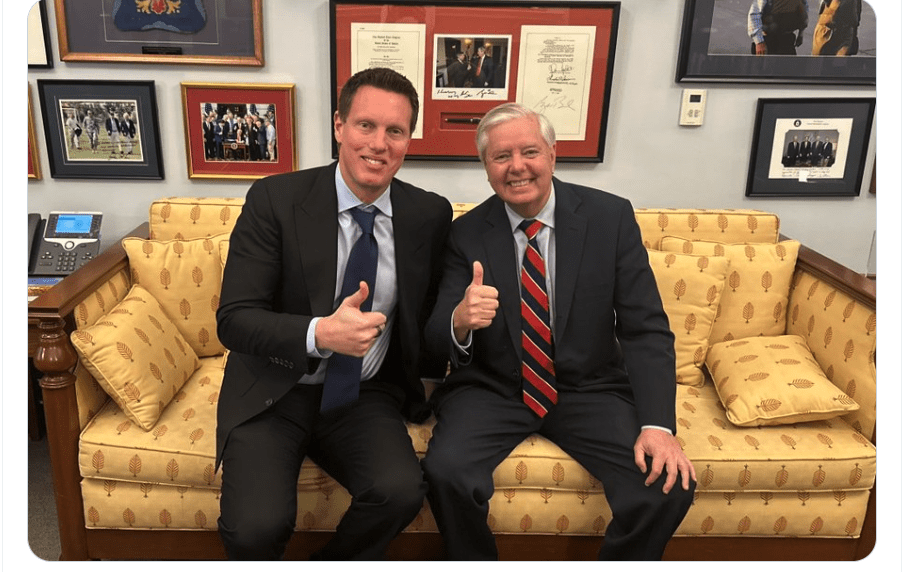
Paramount Skydance CEO David Ellison cheered on President Trump’s State of the Union address as Sen. Lindsey Graham’s special guest.
Sen. Lindsey Graham via X
At the end of February, Donald Trump received good news about the future of the U.S. news industry.
His billionaire friends at the helm of Paramount Skydance had won a bidding contest to acquire Warner Bros. Discovery and its many holdings across the news and entertainment sector.
But what’s good news for this president is bad news for our democracy and the constitutional rights that safeguard people across the United States from tyranny.
Trump had lobbied for Paramount Skydance to edge out Netflix, the other top bidder for WBD, primarily because he wants to see CNN fall under the heel of the MAGA-friendly Ellison family — son David who runs Paramount, and father Larry who’s helping finance the $110 billion offer.
Few who’ve followed this White House’s relentless efforts to censor and control dominant media outlets were surprised when Netflix stepped aside so that Trump’s cronies could scoop up the company that controls CNN. Deals of such a massive scale are never a good thing.
It’s best to doubt the hype churned out by the few bankers, lawyers, owners and politicians who stand to benefit financially and politically from such bloated corporate combinations. Media consolidation is particularly devastating to the beneficial role a free press plays in democratic society. The negative impacts of mega-mergers reverberate across society, harming the workers who power our media ecosystem, the consumers who demand affordable choices for news and entertainment and the people who need access to diverse perspectives to fully participate in civil society.
Mergers also deal a blow to our First Amendment rights, which allow us to express and share ideas, no matter how controversial. These harms come into sharp focus during times of war. Press freedom is critical at moments when powerful leaders attempt to convince people to put lives at risk for the supposed good of the nation. Propaganda is the province of dictators, warmongers and the media they control. Accurate, independent reporting on the horrors of military conflict, on the other hand, often paves the path to peace.
While mergers of this scale often take a year or more to wind their way through approval processes, there are roadbumps sizable enough to permanently derail Paramount Skydance’s bid. The Justice Department and European regulators will scrutinize the merger. State attorneys general also have a say, and some from California to New York are reportedly mobilizing to challenge the deal.
With so much at stake it’s worth examining the serious consequences that would result from this merger, which would allow one family to manipulate so much of our supposedly free and independent media.
1. Less consumer choice
By design, industry consolidation eliminates market choice. Regulators at the Department of Justice are supposed to place conditions on mergers to mitigate the harms of reduced competition. This includes analyzing the health of the marketplace to ensure there are enough competitive pressures to drive down consumer costs for news and entertainment.
At present, Paramount Skydance and WBD control nearly half of the top 50 most-subscribed-to pay-TV channels. As a merged entity, the new owner would be able to leverage must-have brands like the Food Network, TBS and TNT alongside CBS’ must-have news brand in negotiations with pay-TV providers. Consumers would once again see cable prices skyrocket, giving streaming companies leeway to raise prices as well.
Trump’s Department of Justice has placed loyalty to the White House above the needs of consumers — and will likely accept Paramount Skydance’s claims of consumer benefits from the merger regardless of how dubious they might be.
“Too often, the promised merger benefits are never realized, while post-merger companies face little or no repercussions for breaking these promises,” the Writers’ Guild of America West wrote about big-media deals like this. “Instead, these mergers lead to lower wages, higher consumer prices, fewer or worse consumer choices, and less innovation.”
In January, Free Press Action’s Matt Wood told Congress that consumers would likely be paying more in a limited marketplace of options. “[They] are unlikely to see better content or more choices either, despite the companies’ claims to the contrary,” Wood said.
2. Less wartime accountability
The business side of major media companies loves a war. CNN, for example, saw significant ratings boosts during previous conflicts, including during the opening stages of the Gulf War (1991), the Iraq War (2003), Russia’s invasion of Ukraine (2022) and the Israeli-Hamas conflict (2023).
Media writer Margaret Sullivan reported on the number of mainstream outlets, including ABC, CBS and CNN, who crowed about securing “exclusive” interviews with President Trump, in which the White House spun its various, contradictory and illegal justifications for starting its war with Iran.
In a post about these interviews, former Chicago Tribune editor Mark Jacob noted that “the key to getting mainstream media on board with an illegal war is making them feel like an important part of it.” And while every major news outlet turned their full attention to Trump’s words, few consistently questioned the president’s shaky rationale for going to war against Iran or considered the legality of his actions.
Even with the wall-to-wall coverage of the war itself, “there’s far too little about the fact that it is illegal, since the strike lacked Congressional approval,” notes Sullivan. Expect far fewer challenges to Trump’s wartime agenda in a world where the Ellisons control both CBS and CNN.
Those reportedly bankrolling the Ellison offer include Saudi Arabia’s Public Investment Fund, the Qatar Investment Authority and Abu Dhabi’s L’imad Holding Company — all controlled by countries that support U.S. involvement in the war. It’s reasonable to expect that such deep financial ties to leaders in the region will shape coverage at both CBS and CNN of this and other Middle East conflicts.
3. More propaganda and censorship
Consolidated media tend to buckle to government pressure to silence viewpoints that challenge official views. At the end of 2025, Free Press published a report revealing how media companies colluded with Trump’s administration-wide campaign to silence dissent on a full range of issues. Report author Nora Benavidez compiled, analyzed and catalogued hundreds of individual censorship incidents to reveal close coordination among the White House, government agencies and Trump’s Big Media allies to normalize some of the most egregious abuses of First Amendment rights.
In 2025, I published a survey that rated the 35 largest media companies in the United States by their degrees of capitulation to Trump-administration demands. The resulting Media Capitulation Index finds that the concentration of ownership in the hands of billionaires, private-equity firms and sprawling conglomerates poses a fundamental threat to a functioning democracy.
The index tracks the deep entanglements these media giants have with government interests, including their dependency on government contracts, merger approvals and other official favors. These entanglements bleed into company newsrooms: In the first year of Trump’s second term, nearly every company Free Press investigated had bent the knee to the political powers that be. This included softening coverage of the Trump administration and downgrading prior commitments to represent a diversity of perspectives in their staffing and reporting, while normalizing some of Trump’s most authoritarian actions.
In the most extreme cases, media conglomerates have colluded with the government to silence anti-Trump views. Often, these companies obeyed in advance — spiking presidential endorsements and political cartoons (The Los Angeles Times and Washington Post), laying off prominent news anchors (Warner Bros. Discovery), and sidelining late-night comedians (Disney and Paramount) out of fear that their comedy displeases the president. A combined Paramount Skydance/WBD would be more of the same — and worse.
4. More media-industry layoffs
As the Ellisons move to take control, concerns are ricocheting across internal Signal and Slack threads featuring communications from thousands of WBD employees. According to Status’ reporting, “a chill has settled over CNN” as newsroom staff fear a brutal round of layoffs to come. Add to that the very real concerns that a Trump-friendly Paramount Skydance would prioritize firing reporters and anchors whose reporting the president disfavors.
But the job losses aren’t limited to newsrooms.
To help secure financing for its offer, Paramount Skydance reportedly needs to make $16 billion in cuts over the next 18 months, a figure that likely translates to thousands of pink slips across all of its existing media properties — and WBD’s.
“Even when we were thinking about keeping these businesses together and running, we knew that we had a difficult task ahead of integration,” Netflix Co-CEO Ted Sarandos told Bloomberg after abandoning his company’s offer for WBD. “I can’t imagine doing all that and trying to cut billions and billions of dollars. Today, Paramount has half of the people that they had one year ago. So that gives you some sense of where this is heading.”
5. Even less viewpoint diversity
The past 30 years of mammoth media mergers have created an ever-shifting landscape that a few powerful media owners dominate. But one thing remains constant: Big-media content is often rote and equivocating, maintaining above all else a status quo that reflects a narrow, unquestioning, pro-corporate view of the world.
Industry consolidation in one sector — whether it’s newspapers or broadcasting or even online platforms — spurs consolidation across the entire media ecosystem. Regardless of the types of media properties joining together, their owners argue that mergers are necessary for their companies to survive in a hyper-commercial system.
They say mergers create so-called “synergies” and “economies of scale” that allow them to reach a broader audience with more efficiency. Discovery made a similar argument in 2022 when it sought approval of its acquisition of Warner Bros. from AT&T — yet here we are a few years later being sold the same used car.
In reality, “synergies” translate into less viewpoint diversity in news and entertainment content as conglomerates streamline offerings to serve more generalized audiences at scale. As activist and actor Jane Fonda wrote in the influential Hollywood newsletter The Ankler, these mergers have not just resulted in fewer creative jobs and news sources but also “far less diversity in the stories Americans get to hear.”
Stopping this deal
One of the biggest problems with recent mega-mergers is the lack of scrutiny given to the promises from those who will gain the most from media mashups like this. Changing the narrative around these deals requires a deeper understanding of the damage previous media mergers have done — to the types of content we watch and read every day; to our ability to find a diversity of viewpoints and make the informed decisions that are essential to a healthy, functioning democracy.
If the goal is to serve the public interest, more media consolidation is never the answer. As regulators and state attorneys general turn their attention to Paramount Skydance’s bid to take over WBD, they must prioritize a media system that people actually need over one that further entrenches extreme wealth and power.
* * *
Help Free Press keep fighting media consolidation: Donate today.