What Happens in the Dark . . .
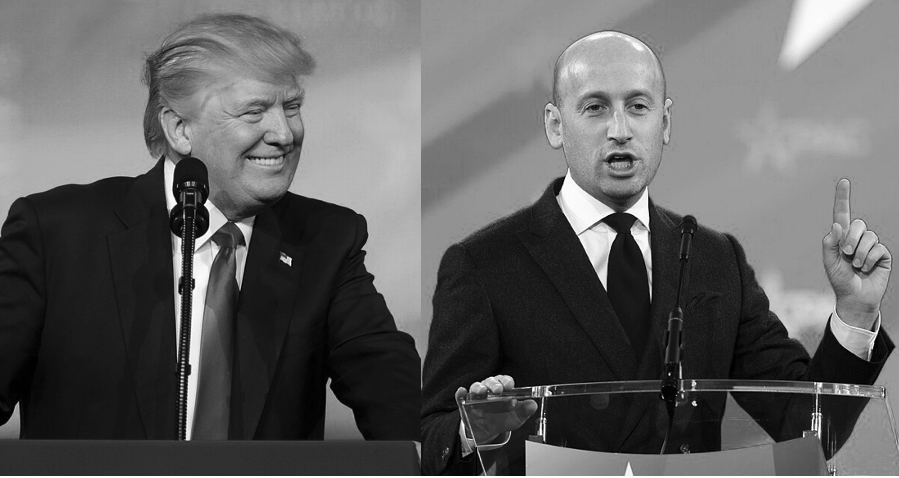
Trump and Miller are the leading advocates of extending the government’s unwarranted ability to spy on people in the United States.
Creative Commons; Wikimedia
House Speaker Johnson’s late-night attempt to “scare up” an extension of the government’s spying authority falls short in Congress.
Like a thief in the night, pro-surveillance members of Congress in the House of Representatives tried to force a vote on a powerful surveillance authority at midnight.
Early Friday morning, the House rejected Speaker Mike Johnson’s attempts to call a vote to renew Section 702 of the Foreign Intelligence Surveillance Act (or “FISA”) for 18 months without any critical reforms to protect Americans’ privacy.
This victory over Speaker Johnson’s, President Trump’s, and Stephen Miller’s schemes came after House Republicans offered a smokescreen compromise that would have renewed Section 702 of FISA for five years while still allowing “backdoor” searches of the data of people in the United States who are caught up in a 702 database that’s supposed to be about collecting foreign intelligence. The fake reforms offered overnight, and voted down after 1 a.m. in a marathon House session, would have made it even easier for the government to use 702 data to prosecute Americans without getting a real warrant.
The speaker attempted to use the cover of night to take away people’s constitutionally protected rights and enhance the president’s ability to further weaponize the government against his perceived “enemies.” These actions ran counter to democratic principles. Free Press Action is part of a bipartisan coalition that has been demanding that lawmakers enact critical reforms to protect the privacy of people in the United States against warrantless surveillance.
After failing to secure a vote on an 18-month extension, the House instead passed a two-week extension. This is a significant win for now, but there is still significant work in the coming weeks to ensure that critical reforms are included in any Section 702 reauthorization. Last night’s vote also shows that Congress is ready to reject the continued violation of our privacy as a result of loopholes that enable abuses under this surveillance authority.
The reforms supported by the coalition are backed by members of Congress on both sides of the aisle, and polling conducted by Free Press in 2024 and more recently by Data for Progress show that the majority of Americans are concerned about government surveillance and do not support renewing this authority as is. Advocates of a “clean” reauthorization (or one without any of the reforms needed to protect Americans’ privacy rights) include President Trump and Stephen Miller, who played a major role in National Security Presidential Memorandum 7 (NSPM-7), the presidential memo that indicated plans to weaponize charges of “domestic terrorism” with the intention of violating the First and Fourth Amendment rights of the president’s political and ideological foes.
Section 702 of FISA has been repeatedly abused to improperly search the communications information of hundreds of peaceful protesters, campaign donors, congressional staff, journalists, federal and state lawmakers and even a sitting judge.
The reforms we need are:
Closing the “backdoor search” loophole
Warrants, subpoenas, and other judicial orders are an important check against government weaponization. By requiring law enforcement and intelligence agencies to justify to judges querying the 702 database for Americans’ communications, the judicial process protects against speculative investigations based on constitutionally protected categories or aimed at suppressing dissent and punishing political detractors. In fact, FISA was enacted as a response to the FBI’s spying on anti-war and civil rights activists in the 1960s and 1970s. A federal court ruled last year that these backdoor searches of Americans’ communications are unconstitutional, and without reform, misuse is likely to continue. Even with spy agencies’ internal rules in place, without an independent judicial check, compliance violations have persisted for years, demonstrating that internal oversight alone is insufficient.
Closing the data-broker loophole
While there’s no positive authority for this and the problem is not limited to Section 702 of FISA, agencies use this loophole to bypass the most significant FISA reform enacted by Congress in over a decade. In 2015, Congress passed the USA FREEDOM Act to ban domestic bulk collections; however, this protection is nullified when agencies can buy data in bulk. As the use of artificial intelligence expands, the risks grow even more significant. AI systems amplify the risks of the data-broker loophole by enabling large-scale analysis of sensitive personal data, making it easier to track individuals, build detailed profiles and make decisions based on opaque algorithms. We already know that agencies like the FBI, DHS, and ICE and the NSA purchase commercially available data on people in the United States, and contracts between AI companies and the Defense Department reveal that these tools may be used for Section 702 collections.
Repealing the expanded definition of Electronic Communications Service Providers (ECSP)
The Reforming Intelligence And Securing America Act (RISAA), the law that reauthorized Section 702 in 2024, dramatically expanded the number of American businesses that can be secretly and warrantlessly compelled to assist the government in tapping into most communications equipment across the United States. In an attempt to fix this dangerous expansion, the Intelligence Act included a provision that narrows that ECSP definition, but it wasn’t enough. We need a meaningful and transparent fix, not just “secret laws” in a healthy democracy.
The idea that in order to be safe and secure, you must give up your rights to speak and express yourself without fear, that you must give up the right to have privacy from government intrusion into your thoughts and beliefs, sounds like something that would be sold to you by Big Brother or Emperor Palpatine. However, it was President Trump who admitted that Section 702 violates our rights and said that we should be glad to give them up. These are the words of an autocrat. Without the right to privacy and the space to express ourselves freely, the foundation of our democracy crumbles.
We are encouraged by Friday’s early-morning result and the failure of attempts to scaremonger and strong-arm House members into extending and expanding this spying power at the eleventh hour. Yet the fight for meaningful surveillance reform continues, and we will be using the next two weeks to shore up our allies in Washington and apply pressure to holdouts.