How Brendan Carr Manufactured an Anti-Trans Panic at the FCC
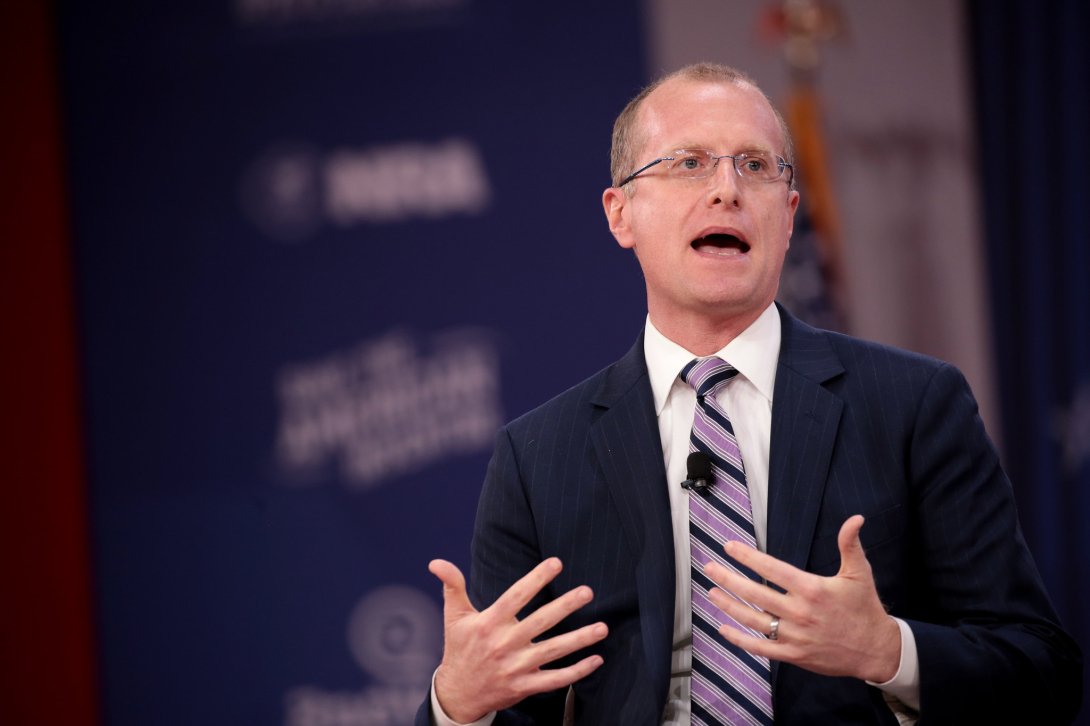
Seeking to score political points with Trump and his allies, FCC Chairman Brendan Carr is trying to stigmatize and undermine the LGBTQ+ community.
Flickr user Gage Skidmore
Trump’s censorship czar, Brendan Carr, is exploiting his perch at the Federal Communications Commission to silence LGBTQ+ voices. Free Press submitted comments in May and June condemning an FCC inquiry into whether the TV industry should modify its voluntary ratings system or apply warning labels to children’s programming that features trans or nonbinary characters.
This initiative is a fishing expedition designed to chill LGBTQ+ perspectives, score political points with Trump and facilitate the administration’s war on diversity, equity and inclusion. And while the notice refers specifically to children’s programming, it would have a chilling effect on both kids’ content and on programming across the board.
In late April, the FCC issued a notice soliciting public comment on the state of the TV parental-ratings system. The notice poses a few seemingly innocuous questions designed to understand “whether the industry’s approach is continuing to provide the information that is relevant to parents today.” Barely hidden among these inquiries is the FCC’s real intent.
The notice claims that “[r]ecently, parents have raised concerns that controversial gender identity issues are being included or promoted in children’s programs without providing any disclosure or transparency to parents. Specifically, the industry guidelines that parents rely on are rating shows with transgender and gender non-binary programming as appropriate for children and young children, and doing so without providing this information to parents, thereby undermining the ability of parents to make informed choices for their families” (emphasis added).
But there’s no real “controversy” here outside of the moral panic the FCC is trying to amplify. And there’s nothing Brendan Carr’s FCC can do about these ratings anyway.
Can the FCC change TV ratings?
No. The FCC is proposing changes that it has no authority to make. In 1996, Congress passed the Telecom Act, which called for the development of parental guidelines for a TV-ratings system. Yet Section 551 of that law allowed the television industry itself to develop a ratings system for television programming that “contains sexual, violent, or other indecent material about which parents should be informed before it is displayed to children.” The ratings system was intended to be both industry-led and voluntary.
The Telecom Act directed the broadcast, cable and film industries to develop that ratings system. And that law allowed the FCC to step in to create a system if, and only if, the industry did not fulfil its role.
This potential FCC authority expired quickly. The only role for the FCC was to review and approve the ratings system, which it did in 1997. The FCC issued a public notice seeking comment — the same mechanism that Brendan Carr has used here. Feedback poured in from parent groups, members of Congress, public-health organizations and other public-interest groups. The industry took note and submitted revised guidelines to the FCC that August, which included content warnings for sex, violence, language and dialogue in addition to the six ratings based on age/maturity-based categories.
In other words, the FCC fulfilled almost 30 years ago the only role it had in this entire congressional scheme to encourage an industry-led ratings system. Suggesting it can circle back and influence these ratings now — nearly three decades later — is nothing but a culture-war exercise in advancing this administration’s odious ideology and hateful politics.
Brendan Carr jumps on Trump’s anti-trans bandwagon
The television-ratings system was implemented in October 1997 and soon became a battleground for those culture wars. Parental concerns, even if they stem from a vocal minority of parents, have long been a vehicle to advance control — or censorship, depending on your perspective — over “controversial media.” Ratings systems in film, music and television have served as a barometer for American culture wars dating back to the social upheaval of the 1960s or Hollywood’s clampdown in the 1930s. The Telecom Act itself, in some ways, grew out of such moral handwringing. In the ’90s, the panic was over the depiction of sex and violence in television and explicit content in music.
The Trump FCC does not provide any evidence supporting the need for its latest inquiry; instead, it references “parents [who] have raised concerns that controversial gender identity issues are being included or promoted in children’s programs without providing any disclosure or transparency to parents.” The truth is that the majority of parents are fine with the television-ratings system, and have been since its inception.
In its 2025 annual report, the TV Oversight Monitoring Board (TVOMB), which was established to manage the ratings system, reported that over 90 percent of parents polled understood the system and considered it helpful. Of the 170 pieces of public correspondence that TVOMB received between Oct. 1, 2024, and Sept. 30, 2025, only 11 related to the TV Parental Guidelines.
Even without any concrete evidence of actual and significant parental concern, the dark subtext of the FCC’s notice is clear: Brendan Carr believes that themes of gender identity are violent, sexual or indecent — and merit regulation. Nothing could be further from the truth. Yet this conflation draws on decades of stereotyping and suppression through the justification of “morality” that codes differences as dangerous. LGBTQ+ allies have fought for greater representation in the media, and it’s their success that now puts a target on their backs for the Trump administration in its quest to erase diversity.
In the wake of the Supreme Court decision legalizing marriage equality in 2015 — and the modicum of bipartisan acceptance that ruling generated for some parts of the LGBTQ+ community — the trans community became even more of a political football for the Republican Party. Anti-equality activists began advancing legislation restricting trans life, from bathroom access to gender-affirming medical care. Republican and MAGA officials in the Trump administration and at all levels of state and local government are using anti-trans rhetoric, spreading misinformation to whip up fear and divide communities. It has also become a way for ambitious administration officials to prove their bona fides to Donald Trump.
To pitch himself for the top position at the Federal Trade Commission, then-Commissioner Andrew Ferguson sent the Trump transition team a memo after the 2024 election promising to use his power to “fight back against the trans agenda.” The second Trump administration has adopted a number of anti-trans policies, beginning with Trump’s executive order to root out what it ridiculously refers to as “gender ideology extremism.” And on June 17, 2026, the FTC announced a lawsuit against the World Professional Association for Transgender Health in an attempt to continue limiting trans access to health care.
Now Brendan Carr is getting in on the action. In a single-minded effort to transform the FCC into an engine of pro-Trump propaganda, Carr has used the power of the agency to censor all sorts of criticism of the president, attacking Jimmy Kimmel Live and other ABC programs, as well as any other networks, programs and speakers not expressly coded as right-wing outlets. The FCC’s notice about TV ratings is just another attempt to dictate what views we are allowed to hold and believe. Censorship and erasure of queer lives is a quintessential element of authoritarian regimes, from Nazi Germany to Viktor Orbán’s Hungary.
The public is largely on the side of the LGBTQ+ community. According to a reply comment GLAAD filed in response to the FCC’s transphobic notice, 63% of Americans do not support the FCC’s action. According to an AI analysis GLAAD conducted of the 37,000+ comments submitted to the FCC, “9 to 1 commenters (90%) support LGBTQ representation without warning labels.” Free Press submitted two comments reaffirming that the FCC has no authority to dictate ratings — noting that this manufactured process is nothing but a vehicle for discrimination. We also submitted to the FCC over 7,800 signatures from people opposing the agency’s morally repugnant exercise.
While the Trump administration has landed heavy blows against our fight for progress and equality, public pressure and outcry continue to make a difference. Censorship relies on compliance, but the response to Brendan Carr’s anti-trans gambit shows that we’ll never go away quietly.
Help Free Press keep fighting Brendan Carr’s dangerous campaign against free speech: Donate today.